New York’s Proposed Leachate Rule Could Leave Millions of Gallons of Contaminated “Garbage Water” Untreated

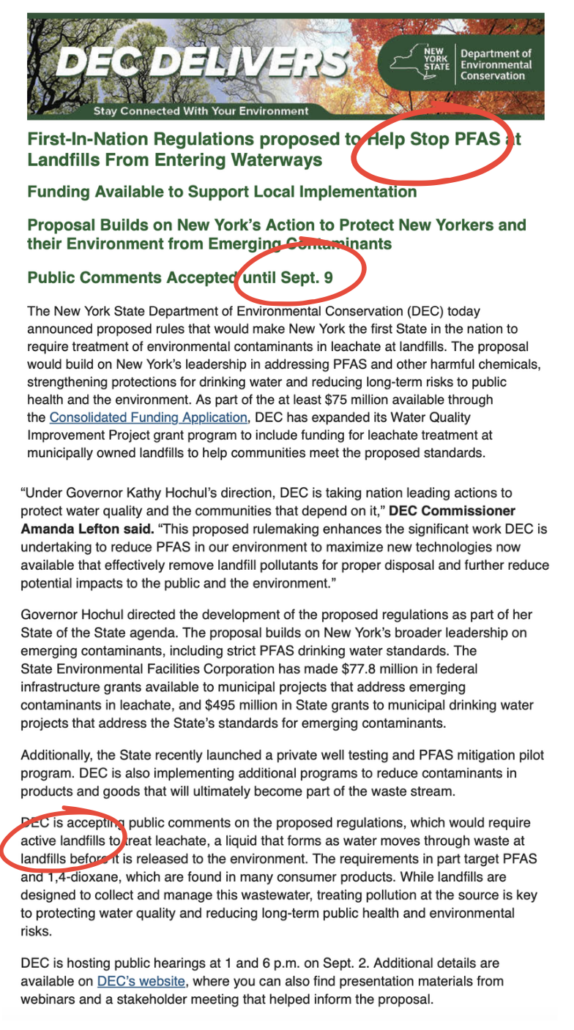
New York’s proposed landfill leachate treatment rule will require certain active landfills to treat leachate before it is discharged into sewage treatment plants or into surface water. However, the regulation contains important exemptions. In addition to currently closed landfills, the proposed rule also carves out an exemption for currently active landfills that will close within two years of the new rule taking effect. Even where a landfill hasn’t reached capacity, DEC has left the door open for operators to choose closure rather than comply with the new treatment rules. (see link, page 20) 

When a landfill is closed, existing landfill regulations require it to be covered with an impermeable cap that prevents precipitation from infiltrating through the trash. The volume of leachate produced by a properly capped landfill declines over time. Nonetheless, inactive landfills can continue producing leachate for decades after closure, making this exemption a significant gap in the proposed rule’s coverage.

Some of New York’s largest leachate generators would be affected if DEC leaves the exemption for recently closed landfills in place.

  1. The City of Albany landfill will reach capacity in fall of 2027.  From 2019-2023, the landfill produced an average of 24,086,437 gallons of leachate per year, the 7th largest volume in NYS. This leachate picks up contaminants from 10,473,637 tons of municipal solid waste, asbestos waste, ash, construction & demolition debris, industrial waste, petroleum contaminated soil, sewage treatment plant sludge, and other materials.
  2. The Ontario County Landfill, located in the town of Seneca, will close at the end of 2028.  The landfill contains 21,712,273 tons of municipal sludge, domestic waste, industrial waste, industrial sludge, construction and demolition debris, coal ash, contaminated soils, tires, shredded automobile fluff, asbestos, and glass.  From 2019-2023, the landfill produced an average of 22,775,583 gallons of leachate per year, the 8th largest volume in NYS. In addition to the currently operating cell, the Ontario County landfill also includes others that have already closed. Cumulatively, Ontario County projects that the landfill will generate an average 5,814,440 gallons of leachate per year for the thirty years after closure. The projection does not include an end date for leachate generation.
  3. Brookhaven Landfill, in Suffolk County, is expected to reach capacity in the second half of 2028.  The landfill’s permit expired in July 2026, but an application to DEC for a five-year extension is pending. The landfill’s most recent permit compliance report cites a total of 23,080,863 tons of ash, construction and demolition debris, and other waste, in two of the six total landfill cells. Totals for the other cells are not reported. Currently, Brookhaven landfill solely accepts ash from Covanta-owned incinerators that burn trash from across Long Island.  From 2019-2023, the landfill produced an average of 29,972,400 gallons of leachate per year, the 3rd largest volume in NYS. 

    This landfill—“a symbol of systemic neglect”—is leaking a groundwater plume of leachate contaminated with perfluorooctanoic acid (PFOA), perfluorooctanesulfonic acid (PFOS), and 1,4-dioxane.  The decision to allow the ongoing disposal of this toxic leachate at sewage treatment plants—which are not equipped to remove these chemicals—is a choice to allow this pollution to spread even further.

  4. In 2025, Waste Connections, the owner of Seneca Meadows landfill, reported a remaining capacity of 1,221,831 tons of trash, less than the landfill consumed in 2024. Nonetheless, the landfill remains open, and rather than planning for closure, Waste Connections is pursing a 47-acre expansion. From 2019-2023, Seneca Meadows produced an average of 65,069,851 gallons of leachate per year, the largest volume in NYS. Waste Connections projects that Seneca Meadows landfill will generate a total of 63,255,270 gallons of leachate in the first four years after closure, followed by 9,385,990 gallons per year until thirty years post-closure. Waste Connections is not required to project beyond that time, so it is unclear when leachate production might end.

    Seneca Meadows landfill already contains 78,344,487 tons of trash from across New York and neighboring states, as well as construction and demolition debris, asbestos, industrial ash, and contaminated soil. People living in the neighboring communities of Seneca Falls and Waterloo “bear the consequences of a waste system that sends garbage from across the state to their doorstep.”


The Takeaway

DEC’s exemption for recently closed landfills could allow four of New York’s top-ten leachate producing landfills to avoid ever having to treat their contaminated leachate. Exempting closed and recently closed landfills from leachate treatment requirements is a mistake. Unless DEC revises its leachate management regulation, these landfills will dispose of millions of gallons of leachate at sewage treatment plants each year for decades, even as leachate treatment infrastructure comes online across the state. DEC is currently reviewing public comments and has until October 2027 to determine whether to make modifications.

To learn more about NYS’s Rulemaking process, watch the Leachate Loophole Coalition’s  Rulemaking webinar


The Comment Period on Leachate Management Regulations Is Over. The Work Continues.

The public comment period for New York’s proposed landfill leachate regulations ended on September 9, but our work is far from over, and we are here for all of it.

More than 100 organizations joined New York River Watch’s coalition comment letter, and more than 700 individuals submitted comments urging the New York State Department of Environmental Conservation (DEC) to strengthen its proposed regulations governing the management and treatment of landfill leachate.

We are also working to obtain and review the comments that were submitted and the September 2 public hearing so that the full public record is available.

DEC now has up to a year to consider the comments it received before issuing a final rule or developing a new proposal. Learn more about the rulemaking process.

In the meantime, we will continue to connect the dots.

Leachate is part of a much bigger picture

Landfill leachate is not an isolated waste issue. It connects landfills to sewage treatment plants, rivers, lakes and drinking water sources, PFAS contamination, sewage sludge, air pollution, climate change, and the larger question of how much waste New York continues to bury.

And we are seeing these connections play out at both the state and federal levels.

A recent Waste Dive report documents pushback from landfill operators, including Casella Waste Systems and Waste Management, against New York’s proposed leachate treatment requirements.

Read the Waste Dive report on industry pushback.

At the federal level, the EPA recently withdrew guidance that provided state permitting authorities with standard language for addressing PFAS through wastewater permits. The guidance was nonbinding, so its rescission does not itself eliminate a legal requirement. But its withdrawal creates additional uncertainty around PFAS regulation and gives states less federal direction at a time when strong action is needed.

Read the Waste Dive report on the EPA’s PFAS wastewater permitting guidance.

The federal regulatory picture is changing, and that makes action at the state level all the more important. New York has the authority and the opportunity to strengthen protections for its waters, regardless of what happens in Washington.

There is more we can do

While we wait for DEC to complete its review, there are concrete ways to keep moving forward. We have gathered current actions from our coalition partners on our Take Action page, and we will continue adding to it as new opportunities arise. Some of them include:

_________________________________________________________________________

URGE GOVERNOR HOCHUL TO SIGN TWO PFAS BILLS

The New York State Legislature has passed two bills that would strengthen protections against PFAS, and both are awaiting the Governor’s signature.

One would establish state limits for PFAS in drinking water as federal protections are being rolled back. The other, the PFAS Discharge Disclosure Act, would require sewage treatment plants to test for PFAS and make the results publicly available. Because landfill leachate can contain extremely high concentrations of PFAS, this information is important to understanding what is entering New York’s rivers and lakes.

Riverkeeper is working to protect the Hudson River and drinking water from PFAS and other pollution, including the impacts of landfill leachate.

_________________________________________________________________________

SUPPORT EFFORTS TO REDUCE RELIANCE ON MEGA-LANDFILLS

Stronger treatment and regulation of PFAS-contaminated landfill leachate are critical, but protecting New York’s waters also means reducing the amount of waste going into the massive landfills generating contaminated leachate.

Seneca Meadows, New York’s largest landfill, generates up to 200,000 gallons of leachate per day and is seeking a 47-acre, seven-story expansion that could allow it to continue operating through at least 2050. Rather than expanding mega-landfills, New York should follow through on its commitments to waste reduction, reuse, recycling, composting, and other zero-waste solutions that make landfills a last resort.

Seneca Lake Guardian is leading the fight to close Seneca Meadows and move New York away from landfilling statewide. Join their mailing list for updates and ways to help.

_________________________________________________________________________

SUPPORT STRONG LANDFILL AIR REGULATIONS

DEC is also considering new regulations governing landfill gas emissions. People living near landfills are exposed to dangerous air pollution every day, while methane emissions from landfills are a major contributor to climate change.

Full Circle Future is working to strengthen New York’s regulations governing landfill air emissions, including methane and other pollutants that affect nearby communities and contribute to climate change.

Tell New York regulators that you support strong landfill air regulations

_________________________________________________________________________

KEEP SEWAGE SLUDGE OUT OF CONSUMER PRODUCTS

When leachate passes through sewage treatment plants, some toxic chemicals can end up in the sewage sludge produced by those facilities. Sewage sludge is used to produce potting soil, compost, and fertilizer, meaning contaminants can ultimately end up in products used on lawns and gardens.

Just Zero is working to end the practice of spreading toxic, PFAS-contaminated sewage sludge on agricultural fields and advocates for a complete ban on using wastewater solids as farm fertilizer.

Sign Just Zero’s petition calling on big-box garden centers to stop selling products made with sewage sludge.

_________________________________________________________________________

Connecting the dots—and staying together

These issues are connected. What happens at a landfill does not stay at the landfill. Contaminants can move through leachate, sewage treatment systems, sludge, rivers, lakes, groundwater, and the air.

That is why we are continuing to raise the concerns and priorities of our coalition partners and connect these issues wherever they intersect while we wait on the state’s response to new leachate management regulations.

The public comment period may be over, but the work continues. We will keep following the rulemaking, working to obtain the complete public record, tracking developments at the federal and state levels, and looking for opportunities to strengthen protections for New York’s waters. We ask that you do, too.

It is a challenging time. But we will keep going, stay together, and continue making the improvements we can at the state and local levels.

See all current actions and ways to get involved →

More Than 100 Organizations and 700 New Yorkers Demand Stronger Protections from Landfill Leachate

A coalition led by New York River Watch says the proposed regulations on leachate management is an important step, but New York must close loopholes and stop the perpetual cycling of toxic pollution.

Kingston, NY — More than 100 organizations and 700 individuals have urged New York State to strengthen proposed regulations governing the management and treatment of landfill leachate as the public comment period comes to a close on September 9, 2026.

The effort is being led by New York River Watch, in partnership with a growing coalition of partners that includes Hudson Riverkeeper, Seneca Lake Guardian, Earthjustice, WESPAC Foundation, Brookhaven Landfill Action and Remediation Group (BLARG), Talking Rivers, Citizens Campaign for the Environment (CCE), Office of Peace, Justice and Integrity of Creation, Sisters of Charity of New York, Rensselaer Environmental Coalition and other environmental, public health, community, municipal, and civic organizations across New York State.

The coalition’s call for stronger regulations comes as New York River Watch releases a new report documenting the scale of the problem statewide. The organization’s new statewide report tracks more than half a billion gallons of landfill leachate leaving landfills and entering sewage treatment plants each year—where it can ultimately make its way into New York’s rivers and lakes, including waters that serve as drinking water supplies for more than two million people.

Landfill leachate—or “garbage water”—is the contaminated liquid generated when water moves through a landfill. It can contain PFAS and other persistent and potentially harmful contaminants. New York River Watch’s report found that, under current practices, approximately 530 million gallons of landfill leachate are sent annually to sewage treatment plants in New York State, with a significant portion ultimately discharged into rivers and lakes. Many of these sewage treatment plants were designed primarily to treat human waste—not the complex mixture of persistent chemicals and other contaminants found in landfill leachate.

The report reveals why stronger state regulation is needed. Treating leachate at sewage treatment plants does not remove the contaminants it contains. Instead, pollution can be transferred from one part of the waste-management system to another, with contaminants ending up in waterways or concentrated in treatment residuals that are returned to landfills, where they can contribute to increasingly concentrated leachate—creating a cycle in which contaminants re-enter the waste stream and compound the problem.

In their coalition comment letter, more than 100 organizations recognize that the proposed regulations represent an important step forward, while making clear that the rule is not a complete solution to New York’s leachate problem.

“The proposed regulation is an important step, but it doesn’t go far enough,” said Rebecca Martin, Executive Director of New York River Watch. “Our research shows that more than half a billion gallons of landfill leachate are entering New York’s municipal sewage treatment systems every year. We need regulations that address the full lifecycle of this pollution—not simply move contaminants from landfills to sewage treatment plants and, ultimately, into lakes and rivers and our environment. This is an opportunity for New York to establish a truly comprehensive and protective approach. The public is watching.”

“This regulation is a major opportunity for New York State to stop the movement of toxic pollution from landfills into rivers and lakes. To achieve that goal, the regulation must be comprehensive and forward-thinking” said Jen Epstein, New York River Watch Science Director. “This regulation must ensure that all landfill leachate gets treated, that treatment waste is handled responsibly and transparently, and that treatment requirements are based on the best available science.” 

“We absolutely support stronger regulations to keep toxic landfill leachate out of New York’s waterways and drinking water. But regulating this pollution is the bare minimum. It does not give landfills a free pass to keep poisoning our communities. We cannot landfill our way out of this crisis. New York has to stop the pollution at its source, reduce the waste we generate, and close mega-landfills like Seneca Meadows once and for all,” said Yvonne Taylor, Vice President and Co-Founder of Seneca Lake Guardian.

“Our waterways are sacred.  They are not the dumping grounds for waste,” said Monique Fitzgerald, co-founder of Brookhaven Landfill Action and Remediation Group. “The DEC has an opportunity to strengthen the leachate regulations, so that our waterways are cleaned up and protected.  This is the only outcome we will accept.”   

“NYS DEC’s proposed regulations are an important first step toward ensuring that landfill leachate is treated before it reaches New York’s waters, and we applaud the Department for taking action to address this long-standing issue plaguing our waterways,” says Riverkeeper Senior Attorney Drew Gamils. “However, the proposal must be changed to address and mitigate the potential environmental and public health impacts posed by landfill pollution. As written, the regulations would allow at least 74 million gallons of untreated, chemical-laden landfill leachate to continue to be sent each year to sewage treatment plants that were never designed to remove many of these toxic pollutants. New York State has the opportunity to be a national leader in responsible waste management, and we urge the NYS DEC to strengthen these regulations before finalizing them.”

“Clean water is a public trust, and protecting it requires us to confront pollution at its source rather than continually passing it from one part of our waste system to another.” said Nada Khader, Executive Director, WESPAC Foundation. “Communities should not bear the health and environmental consequences of contaminants that our treatment infrastructure was never designed to remove. WESPAC joins organizations across New York in calling for strong, comprehensive landfill leachate regulations that close loopholes, protect our rivers and drinking water, and move us toward a more responsible and sustainable approach to waste. We have both a moral and practical obligation to leave future generations water that is cleaner and not more contaminated than we inherited.”

“We are pleased that DEC is taking steps to address a dangerous, long-standing source of surface water and groundwater pollution,” said Matthew Silverman, Senior Attorney at Earthjustice. “However, we urge DEC to adopt the coalition’s recommendations to strengthen the proposed regulations, such as by including all landfills, and ensuring that the final regulations are grounded in science. In this way, New York can protect our health and environment and lead the nation in regulating leachate treatment.”

“The Sisters of Charity of New York are concerned that DEC’s new regulations to close the leachate loophole are not strong enough,” said Carol De Angelo, SC, Director of Office of Peace, Justice and Integrity of Creation, Sisters of Charity of New York. “Water is a precious gift that we cannot live without. Research shows how leachate in NYS is contaminating its rivers. It also contaminates the air, soil and humans! Harm is done when people’s drinking water contains leachate. We urge the DEC to follow the recommendations of New York River Watch and the coalition. As partners of the Coalition, we call upon DEC to protect the residents of New York State.”

“NYSDEC should be commended for taking action on the leachate issue, but the proposed regulations need to be strengthened,” said Robert Welton of the Rensselaer Environmental Coalition. “The priority needs to be destroying PFAS—not putting PFAS-containing residuals back into landfills. The regulations also need to be comprehensive and include inactive landfills, with priority given to those facilities posing the greatest risk to people. And the process needs to be accelerated so we can start making a difference in stopping this pollution. PFAS released into the air through the burning of landfill gas also needs to be addressed as a top priority in a new and prompt initiative.”

“For too long landfill leachate, garbage water, has been allowed to flow uncollected past the boundaries of inactive landfills. Or, if collected from an active landfill, passed largely untreated and unregulated through municipal waste treatment facilities. We agree that the proposed regulations are a start but they fall far short of protecting our waters, our other-than-human relatives and ourselves from the toxins they contain,” said Lee Willbanks, President and co-founder of Talking Rivers. “The revisions proposed by the coalition led by New York River Watch must be included in any final rule if New York is to make real strides to addressing this current and growing crisis facing our waters.”

“We commend the DEC for taking this critical first step toward addressing the serious threat that toxic landfill leachate poses to our treasured waterways across the state,” said Adrienne Esposito, Executive Director of Citizens Campaign for the Environment (CCE). “However, the Department must go further to strengthen the proposed regulations in order to provide a comprehensive solution that fully closes landfill leachate loopholes. New York State has an opportunity to demonstrate national leadership in protecting clean water and we urge the Department to do so by adopting stronger final regulations.”

Town of Saugerties Takes a Strong Stand on New York’s Leachate Regulations

The Town of Saugerties is taking a strong lead in calling for meaningful changes to New York’s proposed leachate management regulations.

Town Supervisor Fred Costello said the Town supports applying the proposed regulations to closed (inactive) landfills and providing state funding for PFAS remediation.

In a letter responding to the proposed DEC rule, Costello writes that, as a community on the Hudson River, “the quality of its water is of paramount importance.” He notes that Saugerties’ closed landfill contains PFAS, as do many closed landfills that deliver leachate to municipal sewage treatment plants along the Hudson.

The Town is generally supportive of efforts to strengthen the rule, but objects to its apparent exemption for closed landfills. Saugerties also recognizes that addressing legacy PFAS contamination is beyond the fiscal capacity of municipalities and will require state funding.

Thank you to Supervisor Costello, the Saugerties Town Board, and CAC members for recognizing the urgency of this issue and taking a strong stand for clean water and communities along the Hudson River and across the state during this critical public comment period, which closes on Wednesday, September 9 at 5:00 p.m.

Get your comments in!

  • If you are a municipality and want to comment on the record, visit the NYSDEC website
  • If you are an individual and want to take action, visit our ACTION PAGE
  • If you are an organization, consider signing our coalition comment letter, now supported by more than 80 organizations. JOIN THE CHORUS.

NYS Begins Rulemaking on Landfill Leachate Treatment Regulations: Public Comment Period, Request for Extension, and More


On July 1, the New York State Department of Environmental Conservation (DEC) officially opened the public comment period for its proposed landfill leachate treatment regulations.

With the publication of the proposed rule, we have learned that the state is providing a little over 60 days for public comment-a disappointing timeframe given the scope and complexity of the proposal, particularly as the comment period falls during the height of the summer vacation season and includes several significant holidays that reduce the time available for meaningful public review and participation.

Since we began advocating on this issue, we have consistently called for a 90-day public comment period and, together with our coalition partners, submitted a letter to DEC in March requesting that timeframe. We have sent a new letter renewing that request and asking the Department to extend the current comment period by an additional 30 calendar days through October 9 to ensure the public has adequate time to fully review the proposed regulations and provide meaningful feedback.

We have been waiting three years for this rule since it was first announced. At this point, another 30 days is not a meaningful delay-it is an avoidable one.

Concerns Regarding Scope of the Rule

Our team has significant work ahead reviewing the state’s proposed language before we can develop a set of public recommendations. However, based on the state’s press release, one key concern is that the proposed regulations would apply only to active landfills, leaving inactive landfills excluded.

We have been raising this issue since late winter, when it became apparent that the state intended to exclude inactive landfills from the rule. If inactive landfills-most of which are owned by municipalities-remain excluded from the proposed leachate treatment rule, they would also be ineligible for grant funding under the program. This would further limit the tools available to address contamination from these legacy sites.

While inactive landfills generate significantly less leachate than active facilities, they still contribute to the overall issue. By excluding them, the state is continuing to address the problem in a piecemeal way rather than through a more comprehensive approach.

Inactive Landfills and Ongoing Contamination Concerns

New York has approximately 1,900 inactive landfills, the vast majority of which have no leachate controls. Many are legacy disposal sites with documented receipt of hazardous waste and known groundwater contamination concerns. For the limited number of inactive landfills that do collect leachate, the common practice is to transport it to municipal sewage treatment plants (also known as wastewater treatment plants or WWTP) for disposal.

Through the New York State Inactive Landfill Initiative (ILI), DEC has tested groundwater at roughly 30 percent of these sites for PFOA, PFOS, and 1,4-dioxane. PFOA, PFOS, or both have been detected at 96 percent of the landfills tested.

The ILI, funded through the Clean Water Infrastructure Act of 2017, tasks DEC with identifying and addressing inactive landfills that pose threats to public drinking water supplies. However, inactive landfills with confirmed high levels of PFOA and PFOS have continued to be allowed to send leachate to publicly owned treatment works, including facilities that discharge into rivers and lakes that serve as drinking water sources.

What Landfill Leachate Contains

While the state has framed this rule as an effort to help stop PFAS at landfills from entering waterways, that characterization does not fully reflect the broader scope of landfill leachate contamination. Leachate (or “garbage water”) is the liquid that forms when rainfall or snowmelt percolates through a landfill. As it moves through buried waste, it accumulates a complex mixture of contaminants, including heavy metals, pesticides, PFAS, and numerous synthetic organic chemicals.

Among the most concerning are persistent organic pollutants (POPs)-highly toxic chemicals that resist degradation, travel long distances in the environment, and bioaccumulate in people and wildlife over time. Many POPs were banned decades ago under international agreements, yet they continue to be detected in landfill leachate today.

Our forthcoming statewide report, The Leachate Loophole in New York State, further illustrates the complexity of landfill leachate. In leachate samples collected in New York, 8 of the 12 POPs originally identified under international convention were detected, including PCBs, DDT, and dioxins. The continued presence of these chemicals demonstrates that legacy pollutants remain an active component of landfill leachate today, even decades after many were banned.

Treatment Realities: No Silver Bullet

This is a complex issue, and there are no single or “silver bullet” solutions for landfill leachate treatment. Effective management will likely require a combination of technologies-often referred to as a “treatment train” approach-rather than reliance on any one method.

Technologies such as foam fractionation and reverse osmosis can play important roles, but none alone are sufficient to fully address the broad mix of contaminants found in landfill leachate or to ensure long-term protective discharge to New York waters.

There is no “silver bullet” that eliminates the problem entirely, but impacts can be reduced and controlled. A key challenge is the management of treatment residuals. Most leachate treatment systems do not destroy contaminants; instead, they concentrate them into secondary waste streams such as brines, spent filter media, sludges, or captured air emissions. These residuals can contain elevated levels of persistent pollutants and must be safely contained, treated, or destroyed.

If not properly managed, residuals risk simply shifting pollution from water to other pathways. For this reason, residual handling must be treated as an integral part of system design and regulation.

Private landfill operators generate billions of dollars in revenue. If they are in the business of managing society’s waste, then managing the resulting pollution should be part of the cost of doing business-not a burden shifted onto taxpayers, drinking water systems, or downstream communities.

At the same time, responsibility should not end at the landfill gate. Many of these contaminants, including PFAS originally developed for military and industrial applications, entered the waste stream because they were incorporated into countless commercial products. Manufacturers that produce and profit from these chemicals should also bear responsibility for the costs of managing and remediating their impacts.

Creating meaningful producer accountability would send a powerful market signal. If companies were required to internalize the true costs associated with persistent chemicals in their products, they would have a far greater incentive to develop safer alternatives and reduce their use in the first place.

Our Upcoming Statewide Report: The Leachate Loophole

Our major statewide report, The Leachate Loophole in New York State, will be released shortly, providing a comprehensive picture of landfill leachate being sent from both active and inactive landfills to municipal sewage treatment plants across the state.

The report finds that more than half a billion gallons of toxic landfill leachate were sent annually from New York landfills to municipal sewage treatment plants between 2019 and 2023. Approximately one-third of this volume is ultimately discharged into rivers and lakes officially designated as drinking water sources serving nearly two million people.

This includes discharges to major water bodies such as the Hudson River, Mohawk River, Lake Ontario, Niagara River, the New York City watershed, and interstate drinking water systems that serve millions of residents and vital ecosystems.

A series of public webinars will be scheduled alongside coordinated public engagement actions to share findings and support community involvement.

Next Steps

There is no single solution that will eliminate the challenge of landfill leachate-that is the core issue we are facing. During this regulatory process, we should encourage the state to treat this as a systems-level problem rather than focusing narrowly on any one chemical.

Importantly, the complexity of treating leachate should not be used as a reason to maintain the status quo. Instead, it highlights the need for a comprehensive, site-specific, and forward-looking regulatory framework that reflects both the science and the scale of the problem.

We encourage you to follow along and share this work with others. In the months ahead, we will be preparing a major statewide effort to engage communities across New York. We welcome volunteers with relevant expertise-such as lawyers, engineers, chemical scientists, and ecologists-to join us in this work. Any New York State organizations concerned or working on this problem that wish to be part of our Leachate Loophole Coalition are encouraged to reach out to Rebecca Martin at info@newyorkriverwatch.org

This problem will not be solved in our lifetime. However, through these efforts, and with your support, we can improve how the state approaches it. Please join us.

In the meantime, read our FAQ which will be updated periodically.


We are a small but mighty team, but we cannot do this alone. New York River Watch is uniquely focused on this issue. If you believe in this work, please consider supporting it with a donation of any size.