New York Cannot Keep Expanding Landfills and Expect Pollution to Disappear by Yvonne Taylor, Seneca Lake Guardian
This is the first post in New York River Watch’s The Web of Waste guest blog series, featuring perspectives from our partner organizations on the environmental and community issues connected to landfills. By lifting up their work and points of view, we hope to broaden understanding of landfill leachate as part of a much bigger picture.
Read the series intro and find links to other posts here.
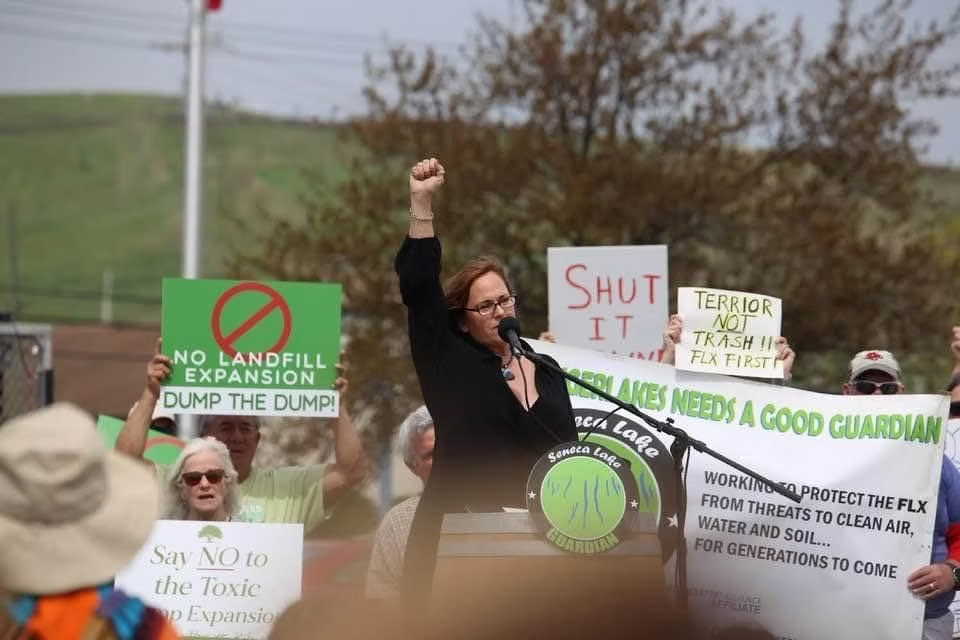
Yvonne Taylor speaks at a rally. Photo credit: Kelly Marciniak (Environmental Health Project)
By Yvonne Taylor, Co-Founder and Vice President of Seneca Lake Guardian
Every day, thousands of tons of garbage arrive in my home region of the Finger Lakes, where New York’s largest landfill towers over our communities, schools, and businesses.
Seneca Meadows Landfill accepts up to 6,000 tons of waste daily and generates roughly 60 million gallons of toxic leachate annually—contaminated liquid produced when water moves through buried garbage. Much of that leachate is transported to municipal sewage plants that aren’t designed to remove harmful contaminants, like PFAS and other “forever chemicals”, before discharging treated water into New York’s rivers and lakes.
This is the reality of New York’s waste system. We bury our garbage in one community, send its contaminated wastewater to another, and expect the environmental consequences to disappear.
They don’t.
As the state considers stronger regulations for landfill leachate, we must confront a larger question: If New York has already committed to reducing waste, why are we continuing to expand the very landfills that generate this pollution?
The true cost of expanding landfills
A recent report from New York River Watch exposes just how widespread the problem has become.
The report found that more than 500 million gallons of landfill leachate were sent to municipal wastewater treatment plants annually between 2019 and 2023, with approximately one-third ultimately discharged into waterways, the sources of drinking water for nearly two million New Yorkers.
At the center of this crisis is Seneca Meadows, which generates more leachate than any other landfill in New York.
Seneca Meadows was expected to reach capacity by the end of 2025. Instead of preparing for closure, its Texas-based operator, Waste Connections, is seeking to continue operations for through at least 2050 by putting waste atop an unlined former superfund site and expanding the landfill by another 47 acres wider and another 7 stories taller.
The landfill continues operating under the State Administrative Procedure Act (SAPA), which allows facilities that submit timely renewal applications to continue operating indefinitely under existing permit conditions, while the Department of Conservation (DEC) reviews their applications.
But this legal loophole doesn’t authorize a landfill to exceed its permitted capacity. And the public still lacks clear answers about how much capacity Seneca Meadows has remaining and how the state is monitoring it.
For those of us living nearby, the consequences are a matter of life or death.
In a Seneca Lake Guardian survey of more than 700 nearby residents, over 70% reported experiencing landfill odors at home. Among households within 10 miles, more than a quarter reported someone diagnosed with cancer, heart disease, asthma, or other respiratory issues.
Meanwhile, the Finger Lakes’ $4 billion wine, agriculture, and tourism economy, which supports more than 60,000 jobs, depends on clean air, clean water, and healthy communities. All of which are threatened by the expansion of Seneca Meadows.
And as New York River Watch’s independent research makes clear, this pollution doesn’t stop at our community’s borders. Families hundreds of miles away are facing the consequences of the garbage buried in Seneca Falls.
That’s why our partnership with New York River Watch is so important. Their team recently visited Seneca Meadows to see the landfill firsthand and hear directly from residents about its impact. Our work together connects the experiences of frontline communities with the broader statewide consequences of landfill pollution. As long as Seneca Meadows stays open, we will all bear the costs.
Stronger leachate regulations are essential. But if we want to stop this pollution at its source, we must also reduce the amount of waste we’re burying in the first place.
We cannot landfill our way out of a waste crisis
Too often we are asked “where will all the garbage go?” when we call for Seneca Meadows’ closure.
The better question is: “Why are we producing and burying so much waste in the first place?”
In 2023, DEC adopted its 2023-2032 Solid Waste Management Plan, which calls for reducing waste, expanding reuse and recycling, and building towards a circular economy.
Yet while New York verbally promotes those goals, it paradoxically considers a massive expansion of its largest landfill.
How can we claim to be building a sustainable waste system, while simultaneously making room to bury millions more tons of garbage for decades to come?
And closing Seneca Meadows shouldn’t mean just transferring its waste to another community. The only solution is reducing our dependence on landfills through investments in waste prevention, reuse, recycling, and composting.
Legislation like the Packaging Reduction and Recycling Infrastructure Act (S1464A) offers a meaningful path forward, requiring large producers to reduce packaging waste and help fund municipal recycling systems. And solutions like these create economic opportunities as well. Recycling, composting, and reuse generate more jobs per ton of material handled than landfilling, while keeping valuable resources circulating through local economies. Without legislative solutions like PRRIA, taxpayers and communities are forced to bear the burden of managing waste.
New York already has a roadmap to curb our dependence on mega-landfills. Now we need the political will to follow it.
It’s time to choose a cleaner future
As DEC considers stronger leachate regulations, New York has an opportunity to better protect waterways and communities across the state. But stronger pollution controls need to go hand in hand with reducing waste generation in the first place.
Governor Hochul and DEC must deny the proposed expansion of Seneca Meadows. And when permitted capacity is reached, the closure of the landfill must be enforced. State leaders should also turn their verbal commitments to zero-waste into actual action and investment. We’ve treated landfills as the foundation of our waste system when they should be a last resort.
My community deserves clean air, clean water, and a healthy place to raise our families – so do the people living downstream from these wastewater treatment plants.
We all deserve a cleaner future, and we need our government to protect it.
Take Action:
- Join Seneca Lake Guardian’s mailing list to help stop the expansion of Seneca Meadows.
- Learn about New York’s Solid Waste Management Plan and urge state leaders to invest in waste reduction, reuse, recycling, and composting.
- Visit New York River Watch’s Leachate Loophole campaign to support stronger protections for New York’s waterways.
Yvonne Taylor is the Co-Founder and Vice President of Seneca Lake Guardian, a New York-based environmental nonprofit working to protect the Finger Lakes’ air, water, public health, and local economy.