NYS Begins Rulemaking on Landfill Leachate Treatment Regulations: Public Comment Period, Request for Extension, and More
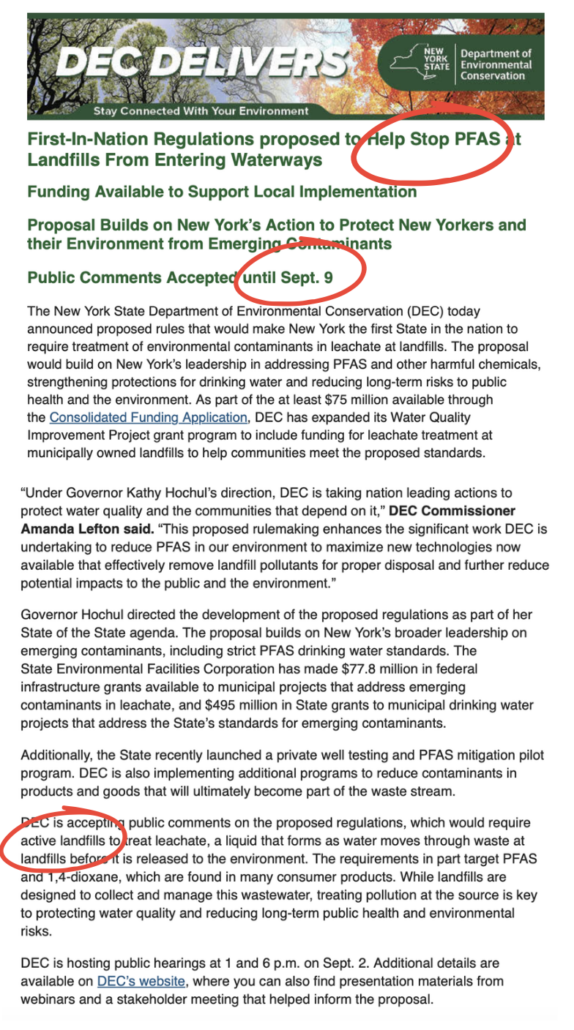
On July 1, the New York State Department of Environmental Conservation (DEC) officially opened the public comment period for its proposed landfill leachate treatment regulations.
With the publication of the proposed rule, we have learned that the state is providing a little over 60 days for public comment-a disappointing timeframe given the scope and complexity of the proposal, particularly as the comment period falls during the height of the summer vacation season and includes several significant holidays that reduce the time available for meaningful public review and participation.
Since we began advocating on this issue, we have consistently called for a 90-day public comment period and, together with our coalition partners, submitted a letter to DEC in March requesting that timeframe. We have sent a new letter renewing that request and asking the Department to extend the current comment period by an additional 30 calendar days through October 9 to ensure the public has adequate time to fully review the proposed regulations and provide meaningful feedback.
We have been waiting three years for this rule since it was first announced. At this point, another 30 days is not a meaningful delay-it is an avoidable one.
Concerns Regarding Scope of the Rule
Our team has significant work ahead reviewing the state’s proposed language before we can develop a set of public recommendations. However, based on the state’s press release, one key concern is that the proposed regulations would apply only to active landfills, leaving inactive landfills excluded.
We have been raising this issue since late winter, when it became apparent that the state intended to exclude inactive landfills from the rule. If inactive landfills-most of which are owned by municipalities-remain excluded from the proposed leachate treatment rule, they would also be ineligible for grant funding under the program. This would further limit the tools available to address contamination from these legacy sites.
While inactive landfills generate significantly less leachate than active facilities, they still contribute to the overall issue. By excluding them, the state is continuing to address the problem in a piecemeal way rather than through a more comprehensive approach.
Inactive Landfills and Ongoing Contamination Concerns
New York has approximately 1,900 inactive landfills, the vast majority of which have no leachate controls. Many are legacy disposal sites with documented receipt of hazardous waste and known groundwater contamination concerns. For the limited number of inactive landfills that do collect leachate, the common practice is to transport it to municipal sewage treatment plants (also known as wastewater treatment plants or WWTP) for disposal.
Through the New York State Inactive Landfill Initiative (ILI), DEC has tested groundwater at roughly 30 percent of these sites for PFOA, PFOS, and 1,4-dioxane. PFOA, PFOS, or both have been detected at 96 percent of the landfills tested.
The ILI, funded through the Clean Water Infrastructure Act of 2017, tasks DEC with identifying and addressing inactive landfills that pose threats to public drinking water supplies. However, inactive landfills with confirmed high levels of PFOA and PFOS have continued to be allowed to send leachate to publicly owned treatment works, including facilities that discharge into rivers and lakes that serve as drinking water sources.
What Landfill Leachate Contains
While the state has framed this rule as an effort to help stop PFAS at landfills from entering waterways, that characterization does not fully reflect the broader scope of landfill leachate contamination. Leachate (or “garbage water”) is the liquid that forms when rainfall or snowmelt percolates through a landfill. As it moves through buried waste, it accumulates a complex mixture of contaminants, including heavy metals, pesticides, PFAS, and numerous synthetic organic chemicals.
Among the most concerning are persistent organic pollutants (POPs)-highly toxic chemicals that resist degradation, travel long distances in the environment, and bioaccumulate in people and wildlife over time. Many POPs were banned decades ago under international agreements, yet they continue to be detected in landfill leachate today.
Our forthcoming statewide report, The Leachate Loophole in New York State, further illustrates the complexity of landfill leachate. In leachate samples collected in New York, 8 of the 12 POPs originally identified under international convention were detected, including PCBs, DDT, and dioxins. The continued presence of these chemicals demonstrates that legacy pollutants remain an active component of landfill leachate today, even decades after many were banned.
Treatment Realities: No Silver Bullet
Our Upcoming Statewide Report: The Leachate Loophole
Our major statewide report, The Leachate Loophole in New York State, will be released shortly, providing a comprehensive picture of landfill leachate being sent from both active and inactive landfills to municipal sewage treatment plants across the state.
The report finds that more than half a billion gallons of toxic landfill leachate were sent annually from New York landfills to municipal sewage treatment plants between 2019 and 2023. Approximately one-third of this volume is ultimately discharged into rivers and lakes officially designated as drinking water sources serving nearly two million people.
This includes discharges to major water bodies such as the Hudson River, Mohawk River, Lake Ontario, Niagara River, the New York City watershed, and interstate drinking water systems that serve millions of residents and vital ecosystems.
A series of public webinars will be scheduled alongside coordinated public engagement actions to share findings and support community involvement.
Next Steps
There is no single solution that will eliminate the challenge of landfill leachate-that is the core issue we are facing. During this regulatory process, we should encourage the state to treat this as a systems-level problem rather than focusing narrowly on any one chemical.
Importantly, the complexity of treating leachate should not be used as a reason to maintain the status quo. Instead, it highlights the need for a comprehensive, site-specific, and forward-looking regulatory framework that reflects both the science and the scale of the problem.
We encourage you to follow along and share this work with others. In the months ahead, we will be preparing a major statewide effort to engage communities across New York. We welcome volunteers with relevant expertise-such as lawyers, engineers, chemical scientists, and ecologists-to join us in this work. Any New York State organizations concerned or working on this problem that wish to be part of our Leachate Loophole Coalition are encouraged to reach out to Rebecca Martin at info@newyorkriverwatch.org
This problem will not be solved in our lifetime. However, through these efforts, and with your support, we can improve how the state approaches it. Please join us.
In the meantime, read our FAQ which will be updated periodically.