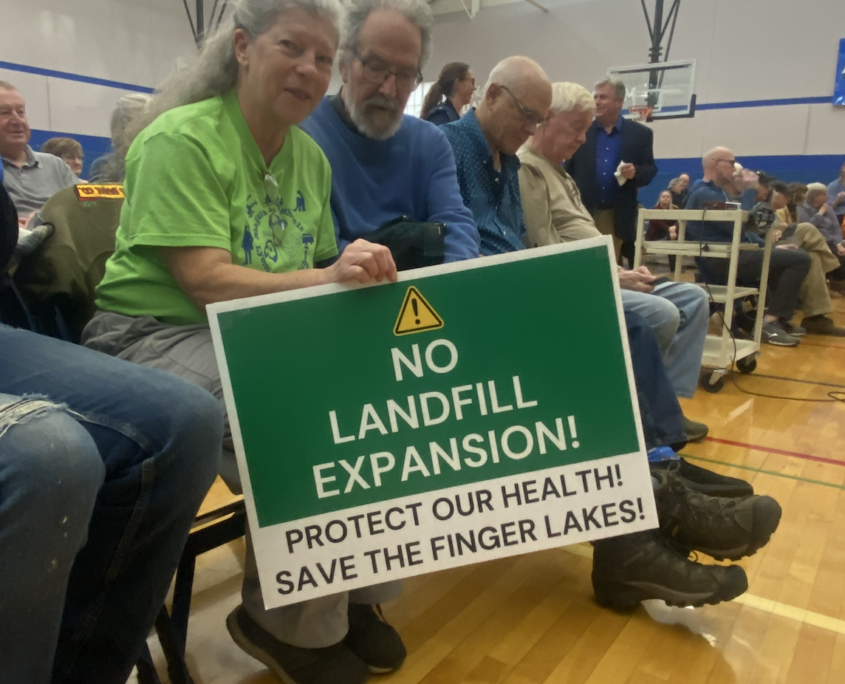
New York Cannot Keep Expanding Landfills and Expect Pollution to Disappear by Yvonne Taylor, Seneca Lake Guardian

This is the first post in New York River Watch’s The Web of Waste guest blog series, featuring perspectives from our partner organizations on the environmental and community issues connected to landfills. By lifting up their work and points of view, we hope to broaden understanding of landfill leachate as part of a much bigger picture.

Read the series intro and find links to other posts here.
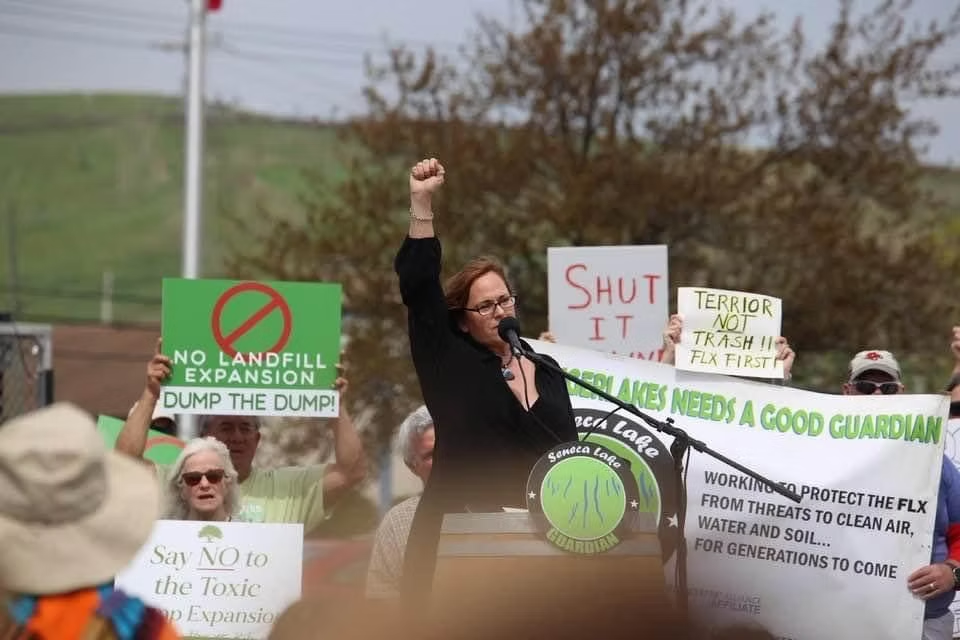
 

Yvonne Taylor speaks at a rally. Photo credit: Kelly Marciniak (Environmental Health Project)

By Yvonne Taylor, Co-Founder and Vice President of Seneca Lake Guardian

Every day, thousands of tons of garbage arrive in my home region of the Finger Lakes, where New York’s largest landfill towers over our communities, schools, and businesses.

Seneca Meadows Landfill accepts up to 6,000 tons of waste daily and generates roughly 60 million gallons of toxic leachate annually—contaminated liquid produced when water moves through buried garbage. Much of that leachate is transported to municipal sewage plants that aren’t designed to remove harmful contaminants, like PFAS and other “forever chemicals”, before discharging treated water into New York’s rivers and lakes.

This is the reality of New York’s waste system. We bury our garbage in one community, send its contaminated wastewater to another, and expect the environmental consequences to disappear.

They don’t.

As the state considers stronger regulations for landfill leachate, we must confront a larger question: If New York has already committed to reducing waste, why are we continuing to expand the very landfills that generate this pollution? 

The true cost of expanding landfills

A recent report from New York River Watch exposes just how widespread the problem has become.

The report found that more than 500 million gallons of landfill leachate were sent to municipal wastewater treatment plants annually between 2019 and 2023, with approximately one-third ultimately discharged into waterways, the sources of drinking water for nearly two million New Yorkers.

At the center of this crisis is Seneca Meadows, which generates more leachate than any other landfill in New York.

Seneca Meadows was expected to reach capacity by the end of 2025. Instead of preparing for closure, its Texas-based operator, Waste Connections, is seeking to continue operations for through at least 2050 by putting waste atop an unlined former superfund site and expanding the landfill by another 47 acres wider and another 7 stories taller.

The landfill continues operating under the State Administrative Procedure Act (SAPA), which allows facilities that submit timely renewal applications to continue operating indefinitely under existing permit conditions, while the Department of Conservation (DEC) reviews their applications.

But this legal loophole doesn’t authorize a landfill to exceed its permitted capacity. And the public still lacks clear answers about how much capacity Seneca Meadows has remaining and how the state is monitoring it.

For those of us living nearby, the consequences are a matter of life or death.

In a Seneca Lake Guardian survey of more than 700 nearby residents, over 70% reported experiencing landfill odors at home. Among households within 10 miles, more than a quarter reported someone diagnosed with cancer, heart disease, asthma, or other respiratory issues.

Meanwhile, the Finger Lakes’ $4 billion wine, agriculture, and tourism economy, which supports more than 60,000 jobs, depends on clean air, clean water, and healthy communities. All of which are threatened by the expansion of Seneca Meadows.

And as New York River Watch’s independent research makes clear, this pollution doesn’t stop at our community’s borders. Families hundreds of miles away are facing the consequences of the garbage buried in Seneca Falls.

That’s why our partnership with New York River Watch is so important. Their team recently visited Seneca Meadows to see the landfill firsthand and hear directly from residents about its impact. Our work together connects the experiences of frontline communities with the broader statewide consequences of landfill pollution. As long as Seneca Meadows stays open, we will all bear the costs.

Stronger leachate regulations are essential. But if we want to stop this pollution at its source, we must also reduce the amount of waste we’re burying in the first place.

We cannot landfill our way out of a waste crisis

Too often we are asked “where will all the garbage go?” when we call for Seneca Meadows’ closure.

The better question is: “Why are we producing and burying so much waste in the first place?”

In 2023, DEC adopted its 2023-2032 Solid Waste Management Plan, which calls for reducing waste, expanding reuse and recycling, and building towards a circular economy.

Yet while New York verbally promotes those goals, it paradoxically considers a massive expansion of its largest landfill.

How can we claim to be building a sustainable waste system, while simultaneously making room to bury millions more tons of garbage for decades to come?

And closing Seneca Meadows shouldn’t mean just transferring its waste to another community. The only solution is reducing our dependence on landfills through investments in waste prevention, reuse, recycling, and composting.

Legislation like the Packaging Reduction and Recycling Infrastructure Act (S1464A) offers a meaningful path forward, requiring large producers to reduce packaging waste and help fund municipal recycling systems. And solutions like these create economic opportunities as well. Recycling, composting, and reuse generate more jobs per ton of material handled than landfilling, while keeping valuable resources circulating through local economies. Without legislative solutions like PRRIA, taxpayers and communities are forced to bear the burden of managing waste. 

New York already has a roadmap to curb our dependence on mega-landfills. Now we need the political will to follow it.

It’s time to choose a cleaner future

As DEC considers stronger leachate regulations, New York has an opportunity to better protect waterways and communities across the state. But stronger pollution controls need to go hand in hand with reducing waste generation in the first place.

Governor Hochul and DEC must deny the proposed expansion of Seneca Meadows. And when permitted capacity is reached, the closure of the landfill must be enforced. State leaders should also turn their verbal commitments to zero-waste into actual action and investment. We’ve treated landfills as the foundation of our waste system when they should be a last resort.

My community deserves clean air, clean water, and a healthy place to raise our families – so do the people living downstream from these wastewater treatment plants. 

We all deserve a cleaner future, and we need our government to protect it.


Take Action:


Yvonne Taylor is the Co-Founder and Vice President of Seneca Lake Guardian, a New York-based environmental nonprofit working to protect the Finger Lakes’ air, water, public health, and local economy.
The Web of Waste: A Guest Blog Series Highlighting Our Partners from New York River Watch

Exploring the connections between waste, pollution, public health, and our communities.

This past summer, the New York State Department of Environmental Conservation (DEC) proposed new regulations that would require landfill leachate to be treated prior to being disposed of at sewage treatment plants or discharged into waterways. Over half a billion gallons of leachate are released into the environment without effective treatment each year. It is important that DEC is taking action on landfill leachate, but the proposed solution does not address the fact that toxic leachate will continue to be produced by landfills in perpetuity. Instead, it creates a new system of leachate treatment infrastructure that will generate byproducts which will need to be disposed of, also in perpetuity, in landfills. 

A better solution would also take steps to eliminate the production of toxic leachate. This would require DEC to take action outside of the immediate scope of the leachate rulemaking, in concert with other state agencies. 

Developing the right solutions requires us to delve into root causes of leachate pollution. What do we bury in landfills? Why does it create toxic leachate? Why there is so much of it? It also requires us to look at impacts beyond the leachate stream, by asking questions such as: What byproducts does this system create? Who do they affect? By exploring these questions, we can see that landfills are part of a larger system that carelessly generates persistent, toxic chemicals, exacerbates climate change, and harms communities and ecosystems at multiple points along the way.

One of the goals of New York River Watch’s Leachate Loophole campaign is to encourage public engagement with state and local decisions involving landfill leachate. Leachate disposal connects landfills, sewage treatment infrastructure, rivers and lakes, drinking water supplies, and lands that are fertilized with sewage sludge. Meaningful engagement requires thinking about interconnected issues.

In the coming months, NYRW will be publishing guest blog posts from partner organizations introducing environmental and community issues that connect with landfills. By featuring these points of view, we hope to support understanding of landfill leachate as part of a bigger picture.

Read the posts here: 

November 2, 2026:  New York Cannot Keep Expanding Landfills and Expect Pollution to Disappear, by Yvonne Taylor, Co-Founder and Vice President of Seneca Lake Guardian


Seneca Meadows and the Communities Paying the Price for New York’s Garbage


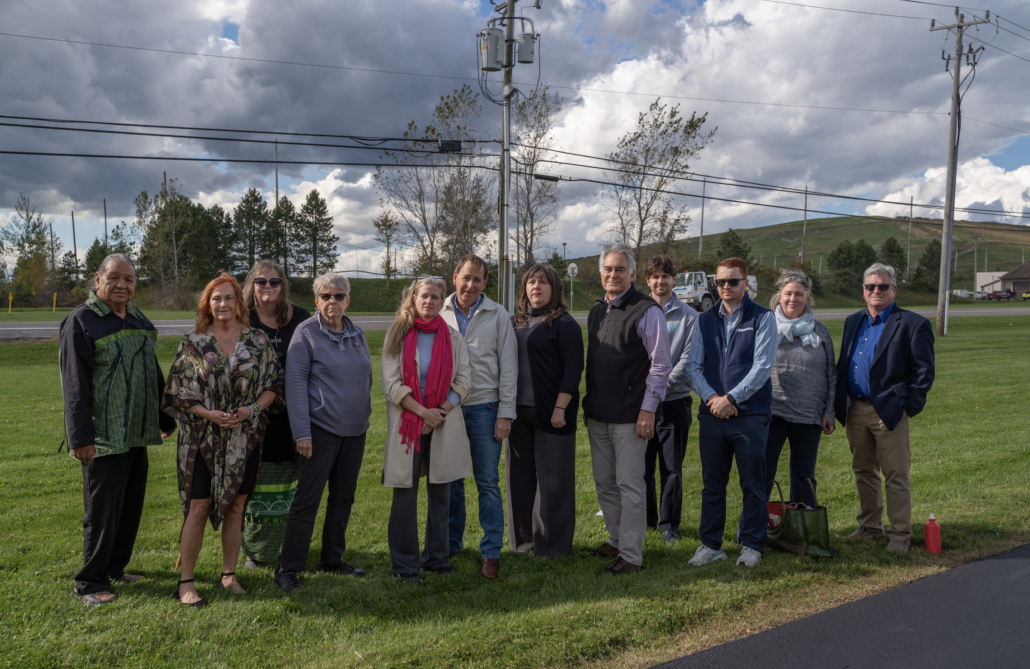
Sachem Sam George of the Gayogohó:nǫ (Cayuga) Nation; Yvonne Taylor, Co-Founder and Vice President of Seneca Lake Guardian; Debbie George, wife of Chief Sam George; Beth Gallagher, Assemblymember Emily Gallagher’s mother; Assemblymember Anna Kelles; Doug Avery, former Member of the Seneca Falls Town Board; Assemblymember Emily Gallagher; Assemblymember Al Stirpe; Jackson Marko, Legislative Coordinator; Mark Pitifer, Marketing & Communications Administrator, Government & Public Relations at Waterloo Container; Rebecca Martin, New York River Watch; Joseph Campbell, Co-Founder and President of Seneca Lake Guardian. Seneca Meadows in the background


By Rebecca Martin, New York River Watch

Click the links throughout the post to watch video footage from the site.

Last week, I traveled 224 miles from my home in Kingston, NY to Seneca Falls and Waterloo to tour Seneca Meadows Landfill, organized by our partners at Seneca Lake Guardian. As co-founder and lead organizer of New York River Watch, I wanted to see firsthand the landfill at the center of so many concerns  about waste, pollution, and public health in New York State. What I saw, and what we heard from the people who live and work nearby, reinforced why this issue matters far beyond the Finger Lakes.

Seneca Meadows is New York State’s largest active landfill, but the word landfill hardly conveys its scale. The site spans 2,600 acres, including nearly 400 acres of landfill, and rises roughly 300 feet above the surrounding landscape. From a distance, its towering mass looks more like a mountain range than a garbage dump.


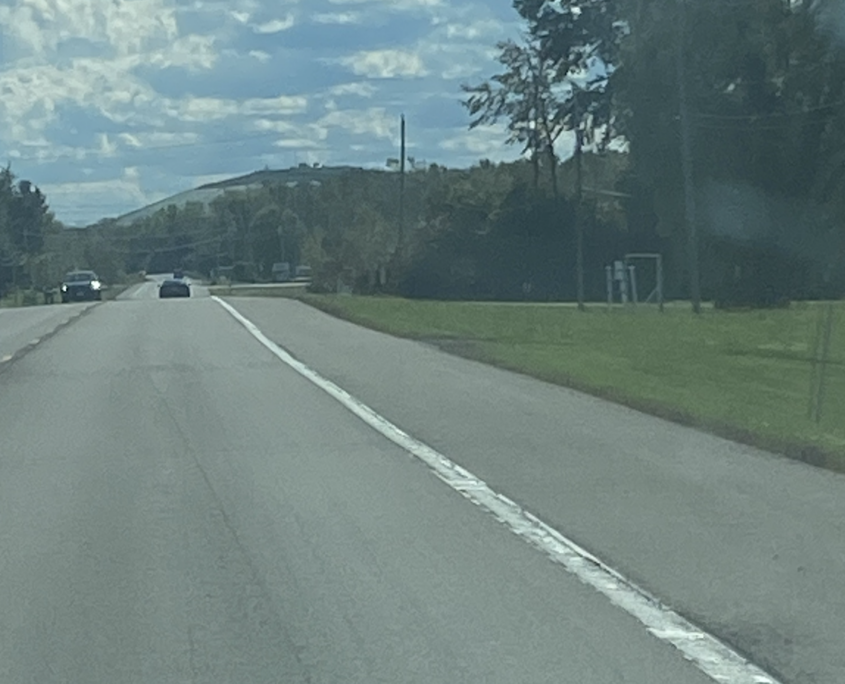
Driving toward Seneca Meadows Landfill after exiting the highway. With Waste Connections’ billion-dollar profits, they can make a mountain of garbage look almost like a natural mountain. But the stench gives it away.


Waste disposal at the site dates back to 1958, when it operated as a local dump. In 1983, it became Seneca Meadows, marking the beginning of the operation we know today.

Owned by Waste Connections, Seneca Meadows accepts approximately 6,000 tons of garbage daily from about 47 New York counties, as well as other states and Canada. A substantial amount comes from New York City. Communities hundreds of miles away, including my own in Ulster County, send their waste here.

The 16,000 people who live in Seneca Falls and Waterloo, NY, are left to bear the consequences of a waste system that sends garbage from across the state to their doorstep, turning their communities into sacrifice zones for everyone else’s convenience.

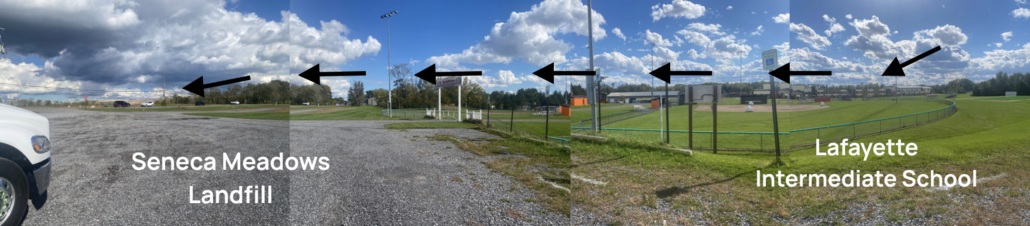
The landfill’s footprint is enormous, but its impacts extend well beyond its boundaries. Homes, businesses, schools, and historic sites sit nearby. Lafayette Intermediate School is approximately half a mile away as the crow flies, and six school buildings in the Waterloo and Seneca Falls school districts are within three miles, according to information shared during our tour.


We also learned that Waste Connections had purchased many homes around the landfills perimeter.  
Some stood abandoned; others remained occupied by people living with its daily impacts, likely not having any options. For families who may have lived here for generations, losing a home can mean losing a piece of their family history, their community, and their way of life. When Waste Connections buys their homes, residents who remain may find themselves in a more vulnerable position, living in homes they no longer own while the company that owns them has a direct stake in local decisions. That shift in power may make residents less willing to speak out at Town Hall about the impacts of the landfill on their lives, and their community.

There is a certain shrewdness in buying properties after a landfill has diminished their value, especially for a corporation that reported more than $1 billion in net income in 2025.

Seneca Meadows’ permit was set to expire at the end of 2025. Waste Connections has applied for a 15-year expansion, known as the “valley infill” project, that would allow the landfill to continue operating through 2040. But that timeline may be far longer. The 15-year clock would not begin until new permits are issued, if they are issued at all. That could mean Seneca Meadows continues operating until 2050 or beyond.  

Or until it reaches capacity. During my afternoon visit, truck traffic into the landfill seemed surprisingly light. Community members told us the company was limiting truckloads to slow the landfill’s approach to capacity while awaiting a permit decision.

Meanwhile, the NYS Department of Environmental Conservation has not released the environmental impact statement for public comment, leaving the community in limbo while the expansion review continues. The proposal has drawn strong opposition from community members and environmental groups, including our allies at Seneca Lake Guardian.

Living in the shadow of a landfill

Community members described persistent odors and concerns about air quality. Nearby businesses have reported difficulties attracting and retaining employees because of the smell. I experienced it firsthand as I drove around Seneca Falls and Waterloo, on my way to the sewage treatment plant and the community center where a town hall would be held.

Like hitting a warm current in a cold lake, the stench would find me without warning, filling the air before receding as I drove on. I began to notice where it struck: beside homes, along farmland, near playgrounds. And then there was the landfill’s perimeter misting system, spraying an odor-control product into the air in an apparent attempt to mask the stench, while likely adding to the ghastly soup of chemicals in the air.

Even with a steady breeze, the smell was overpowering near the leachate holding tanks. More than a million gallons of “garbage water” sat in these tanks waiting to be trucked away. Just beyond them stood a willow tree, a quiet remnant of the landscape that existed before Seneca Meadows opened in the 80’s. The willow stood as a reminder of the natural landscape that the landfill replaced.

I grew up in a Maine mill town where the paper mill’s stench hung over the community day after day. People called it “the smell of money,” as if the jobs justified the pollution. Driving through Seneca Falls and Waterloo, I thought about that phrase differently. Seneca Meadows employs an estimated 100–160 people while taking communities’ garbage from across the state and beyond for profit. As horrible as my hometown’s paper mill was, it employed thousands of families. Neither industry has a license to pollute, but the economic benefits are hardly comparable to the burden. What has Waste Connections actually brought these communities to justify decades of living with a mega-landfill?

An educational center where no-one goes!

The public health concerns go far beyond odor. From 2019 to 2023, Seneca County’s age-adjusted lung cancer incidence rate was 70.7 cases per 100,000 people per year, about 36% higher than the national rate. A separate state review also found elevated lung cancer diagnoses in specific census tracts in Seneca Falls and Waterloo over a 26-year period.  

We need a different approach to waste

“Out of sight, out of mind” has become New York’s waste management strategy. We send our garbage elsewhere and leave other communities to live with the consequences. Massive landfills like Seneca Meadows and Colonie in New York State are not solutions; they are symptoms of a failed system.

If we all spent a week living beside a large garbage dump like Seneca Meadows and experiencing its scale, the stench, and the losses borne by the surrounding community, we might stop treating mega-landfills as an acceptable solution to our waste.

We need mandated zero-waste planning backed by dedicated funding for coordinated implementation. Above all, local governments, businesses, and community members must work together to reduce its waste, expand reuse and recycling, and make landfills, when necessary, the absolute last resort.


TAKE ACTION

  1. Sign up for Seneca Lake Guardian’s mailing list. Sign up for Seneca Lake Guardian’s mailing list now so you’re ready when public comment opens on Waste Connections’ proposed expansion of Seneca Meadows. They will make it easy to personalize and submit a comment. We need thousands of voices saying: No more mega-landfills. Close Seneca Meadows.  
  2. Tell your state legislators to implement New York’s Zero Waste Plan. New York adopted its 2023–2032 Solid Waste Management Plan, but a plan on paper means little without action. Urge your New York State senators and assemblymembers to prioritize waste reduction, reuse, recycling, and composting—and stop expanding our dependence on landfills and incineration.
  3. Visit New York River Watch’s Leachate Loophole campaign. Learn how landfill leachate threatens our waterways and drinking water, and find out how you can take action to close the loophole.


NY Assemblymembers Gallagher, Kelles, and Stirpe Tour Seneca Meadows as Community Calls on State to Reject Landfill Expansion


Rebecca Martin joined our partners at Seneca Lake Guardian for a tour of Seneca Meadows Landfill, where we heard directly from impacted community members and local business owners about the landfill’s effects on their community. We’re sharing the following press release from Seneca Lake Guardian, and will share our own reflections and photos from the day shortly.

###

SENECA FALLS, NEW YORK — Last night, New York State Assemblymembers Emily Gallagher and Anna Kelles joined Seneca Lake Guardian, local residents, business owners, and community leaders in Seneca Falls for a community town hall focused on the future of the Seneca Meadows, Inc. landfill (SMI) and its proposed expansion. Over 100 residents packed the Seneca Falls Community Center to share stories about life in the shadow of New York’s largest landfill and call for change.

Ahead of the town hall, Gallagher and Kelles were joined by Assemblymember Al Stirpe for a tour of the area surrounding Seneca Meadows, New York’s largest landfill, to see its impact on neighboring communities firsthand. The lawmakers also met with local stakeholders to hear directly about their experiences living and working near the landfill, and their concerns about its continued operation.

“For too long, waste management policy in New York has overburdened communities like Seneca Falls, blowing past our reduction targets instead of seriously committing to more sustainable practices,” said Assemblymember Emily Gallagher. “As the Chair of the Committee on Solid Waste Management, I’m grateful to the advocates, business owners, and community members who shared their experiences with me. It’s clear that approving the extension of Seneca Meadows landfill would only move us in the wrong direction — we must shut down SMI once and for all and commit to waste reduction and diversion policies like PRRIA to change our state’s trajectory and avoid the impending solid waste crisis we’re facing.”

“Residents were clear: living in the shadow of New York’s largest landfill is dangerous and damaging. They described the effects on the air they breathe, the water they drink, and students’ ability to focus in class and enjoy time outside,” said Assemblymember Anna Kelles. “The state’s own review of health around the landfill found 51% more lung cancer cases than expected among men and 44% more among women in one nearby area. In a survey of people living within 10 miles, about one in four said someone in their household had been diagnosed with asthma or another respiratory illness since living near the landfill, and about one in four reported a household diagnosis of cancer or heart disease. The DEC must take these findings and the community’s concerns seriously and reject Seneca Meadows’ proposed expansion. I am proud to stand with the Finger Lakes community in calling for bold action to shut down the landfill and adopt more sustainable waste management practices,”

“The DEC has ignored Seneca Falls’ small business owners, who are struggling to retain employees and attract customers because of the sight and smell of the landfill, for too long. As the Chair of the Committee on Economic Development, I know that small businesses – from winemakers to auto dealers – across the region are already under immense pressure from rising costs,” said Assemblymember Al Stirpe. “Expanding the Seneca Meadows landfill may be the final straw for the small businesses that form the bedrock of this community.”

The visit comes as the New York State Department of Environmental Conservation reviews Seneca Meadows’ proposal to expand its footprint by 47 acres and continue operations through at least 2050. Residents and advocates raised concerns about what decades of additional landfilling could mean for public health, air and water quality, quality of life for the community, and the Finger Lakes’ agriculture and tourism-driven economy.

At the evening town hall at the Seneca Falls Community Center, Gallagher and Kelles heard from a panel of residents, business owners, health experts and advocates about the effects of living and working near the landfill, including Yvonne Taylor of Seneca Lake Guardian, Mark Pitifer representing Waterloo Container, Sachem Sam George, Member of the Haudenoshonee Nation, Doug Avery, a former Town Board Member, Michelle Grillone, a parent in the local school system, and Vinny Aliperti, the owner of Billsboro Winery. Concerns ranged from odors and truck traffic to potential impacts on water quality, public health, and the region’s economy. Community members also had the opportunity to ask questions and share their own experiences.

In keeping with the event’s focus on protecting the Finger Lakes from the impacts of waste, Seneca Lake Guardian partnered with Dish Truck to provide reusable plates and cups for food and drinks served at the town hall, helping ensure the event itself does not contribute additional waste to the landfill.

Seneca Meadows is New York’s largest landfill and is likely the state’s largest single point source of methane emissions. The landfill generates up to 200,000 gallons of leachate each day containing PFAS, or “forever chemicals,” which is transported to wastewater treatment facilities across New York that generally are not equipped to remove PFAS before treated water is discharged into waterways. Locally, a recent survey of more than 700 residents documented widespread health and quality-of-life concerns, with nearby residents reporting headaches, breathing issues, dizziness, and irritation associated with landfill odor events. The area surrounding the landfill has also been identified as a lung cancer cluster.

“The Finger Lakes are not New York’s dumping ground,” said Yvonne Taylor, Co-Founder and Vice President of Seneca Lake Guardian. “Families here have lived with threats to our water and health long enough. Today, our elected leaders from across the State saw firsthand what this community stands to lose if Seneca Meadows is allowed to grow even larger. Enough is enough. Our homes and our future are worth more than another 25 years of garbage.”

“Working people deserve clean air, clean water, and a healthy place to live, work, and raise their families,” said Todd Hobler, Executive Vice President of 1199SEIU. “The communities around Seneca Meadows have carried the burden of New York’s waste for long enough. We stand with Finger Lakes residents calling on the state to protect their health and their future and reject the landfill’s expansion.”

“I work directly across from the Seneca Meadows landfill every single day, and I have witnessed firsthand the growing impact this facility has on the people and businesses of Seneca Falls. Over the years, the odors have become increasingly severe, truck traffic has intensified, and concerns surrounding emissions have only grown,” said Mark Pitifer, Marketing & Communications Administrator, Government & Public Relations at Waterloo Container. “From where we sit, it is clear that Waste Connections has not demonstrated an ability to adequately control the impacts of its existing operation. Yet it is our employees, neighboring businesses, homeowners, and the broader community who are forced to live with the consequences. Against that reality, the prospect of the New York State Department of Environmental Conservation extending the life of this landfill—and potentially authorizing an expansion of an already enormous industrial footprint—is deeply troubling. Before any discussion of expansion can even be considered, the serious and persistent problems associated with the facility as it operates today must be addressed. Seneca Falls should not be asked to accept decades more of these impacts simply because they have been tolerated for decades already.”

“The Haudenosaunee views Mother Earth as a living relative rather than a resource, carrying a sacred obligation to preserve the land, water, and all living things in reciprocal balance. Therefore we all have a responsibility to protect our environment, air, and water, and preserve the land and its environment for the faces to yet be seen. Every decision made today must ensure the water, air, and land remain healthy for seven generations into the future. Seneca Meadows puts all of that at risk. From the 200,000 gallons of polluted leachate produced everyday to the massive volume of methane emissions the landfill pumps into the atmosphere, we are calling on the State to stand with us to protect the Finger Lakes and New York’s environment at large. Denying SMI’s expansion and shutting down the landfill is a matter of life and death,” said Sachem Sam George of the Gayogohó:nǫ (Cayuga) Nation. 

“As a former member of the Seneca Falls Town Board and a longtime Seneca Falls resident, I’ve seen our community fight for its dignity, only to be pushed aside to protect Seneca Meadows’ profits. It is time for the DEC to listen to the people of Seneca Falls and the countless advocates, residents, neighboring towns and counties, elected officials, business owners, and institutions who have called for the immediate closure of Seneca Meadows. I’m grateful to Assemblymembers Gallagher, Kelles, and Stirpe for taking the time to hear from our community and discuss the best course of action,” said Doug Avery, former Member of the Seneca Falls Town Board.  

“The emissions and odors coming from Seneca Meadows landfill leave my children feeling dizzy, nauseous, and disgusted, preventing them from going to school or enjoying outside activities,” said Michelle Grillone, lifelong resident and mother of three children. “We deserve better. It is the State’s responsibility to protect our health and our environment, and today, they are failing. We demand decisive action from the Department of Environmental Conservation to shut down Seneca Meadows and allow all of our children to live safely and freely.”

“As a local winemaker and business owner, my livelihood depends on the health of our air, climate, soil and waterways – and a steady stream of tourists visiting the Finger Lakes to enjoy its natural beauty. Expanding Seneca Meadows landfill by 47-acres threatens to cut off my customer base, as tourists start to see Seneca Falls the same way New York State seemingly does – as a trash dump,” said Vinny Aliperti, owner of Billsboro Winery.

“Today, we heard a story that is all too common across this state: a community’s voice being pushed aside by the special interests of a polluter. The residents, advocates, and business owners of Seneca Falls have been forced to fight for their basic rights: clean air, clear water, and a healthy environment. The state must do the right thing by denying the proposed expansion and immediately closing Seneca Meadows to finally deliver the long-overdue justice Seneca Falls deserves,” said Rebecca Martin, Director of Community Partnerships and Training at Beyond Plastics and Co-founder of New York River Watch.

###

About Seneca Lake Guardian. Seneca Lake Guardian is a New York State not-for-profit Corporation with 501(c)(3) and is dedicated to preserving and protecting the health of the Finger Lakes, its residents and visitors, its rural community character, and its agricultural and tourist related businesses through public education, citizen participation, engagement with decision makers, and networking with like-minded organizations.