21 Organizations Ask NYSDEC for More Time to Review Proposed Landfill Leachate Rule

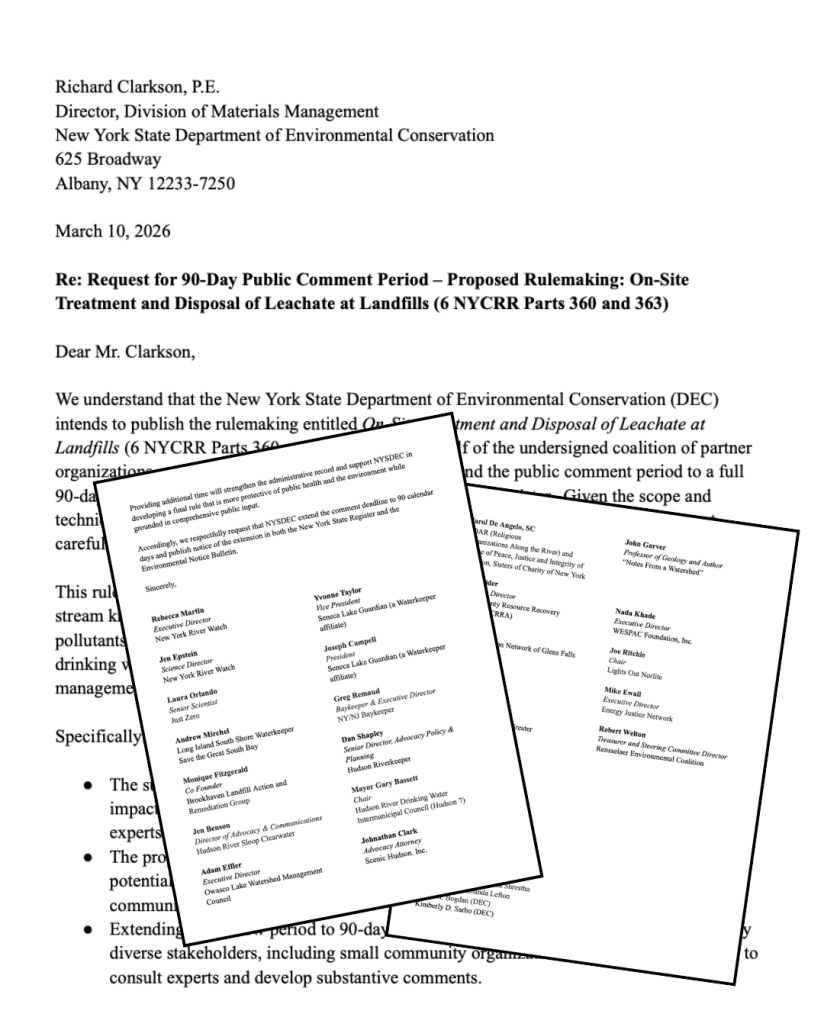
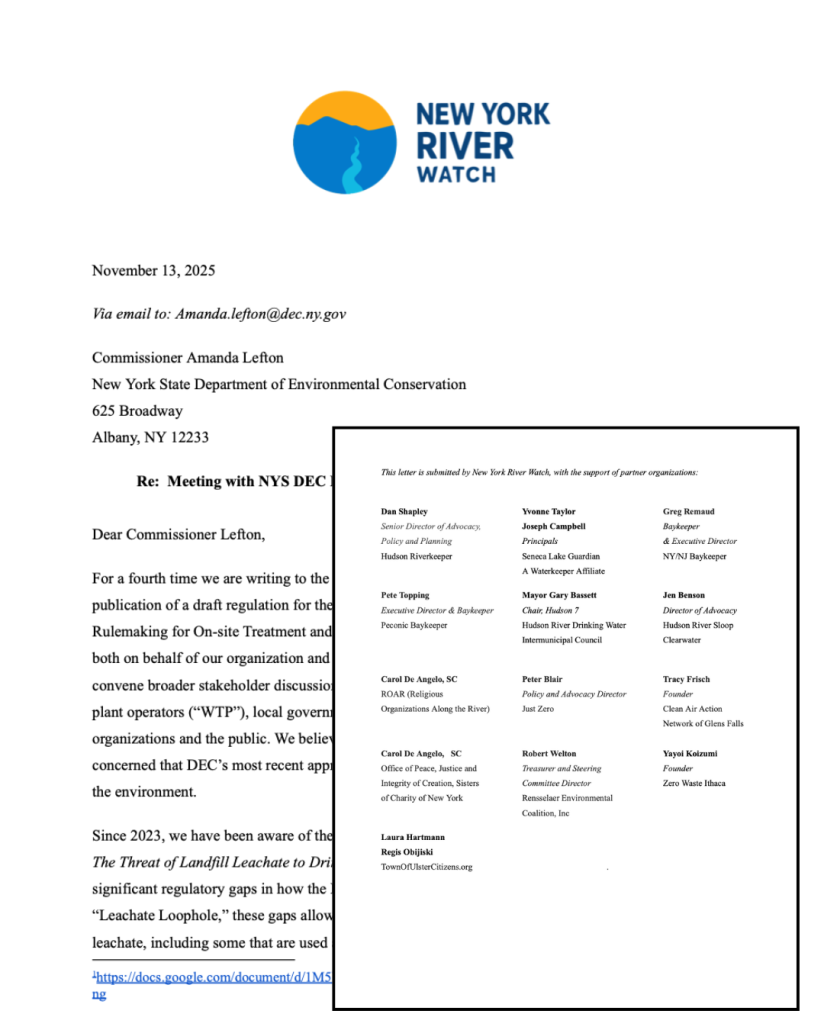
Today, 21 environmental and community organizations sent a letter to the New York State Department of Environmental Conservation (NYSDEC) asking the agency to provide a 90-day public comment period for its upcoming rule on how landfill leachate is treated and disposed of.

The coalition submitted the request ahead of the rulemaking process beginning, asking the Department to commit to a longer comment period once the proposal is officially published.

Leachate is the contaminated liquid that forms when rainwater and other liquids pass through landfill waste. This liquid can contain a mix of harmful pollutants, including PFAS (“forever chemicals”) and other substances that can threaten drinking water,  public health and the environment.

Because of the potential impacts on local communities, drinking water supplies, and wastewater treatment systems, the organizations are asking the state to allow enough time for the public to carefully review the proposal.

The groups note that the rule is complex and technical, and that communities, local governments, scientists, and environmental organizations will need time to understand what the proposal could mean for their regions.

A 90-day public comment period would give people across New York the opportunity to review the proposal, consult experts, and submit meaningful feedback before the rule is finalized.

The coalition also asked NYSDEC to publish notice of the extended comment period in both the New York State Register and the Environmental Notice Bulletin so that communities across the state are aware of the opportunity to participate.

TAKE ACTION!  Urge the DEC to open the Rulemaking Process with a 90-day public comment period.

DONATE!  Consider a donation of any size to support this important work.


Understanding the Risks of Using Leachate Residual as Landfill Cover

Takeaways

  • As New York State Department of Environmental Conservation (DEC) develops rules requiring landfills to treat leachate prior to disposal at municipal Sewage Treatment Plants (STPs), we must also address what will be done with the concentrated toxic contaminants  once they are removed. 
  • The state has suggested that this concentrated material – sometimes called “residual” – could be placed on top of the landfill each day as an alternative daily cover (ADC) – material used “to control disease vectors, fires, odors, blowing litter, and scavenging.”
  • Currently, landfills in New York routinely use materials such as contaminated soil, municipal solid waste (MSW) ash, auto shredder residue, and construction and demolition (C&D) debris as daily cover. 
  • The use of concentrated leachate treatment residuals as alternative daily cover at landfills should not be allowed.

Why are we talking about alternative daily cover?

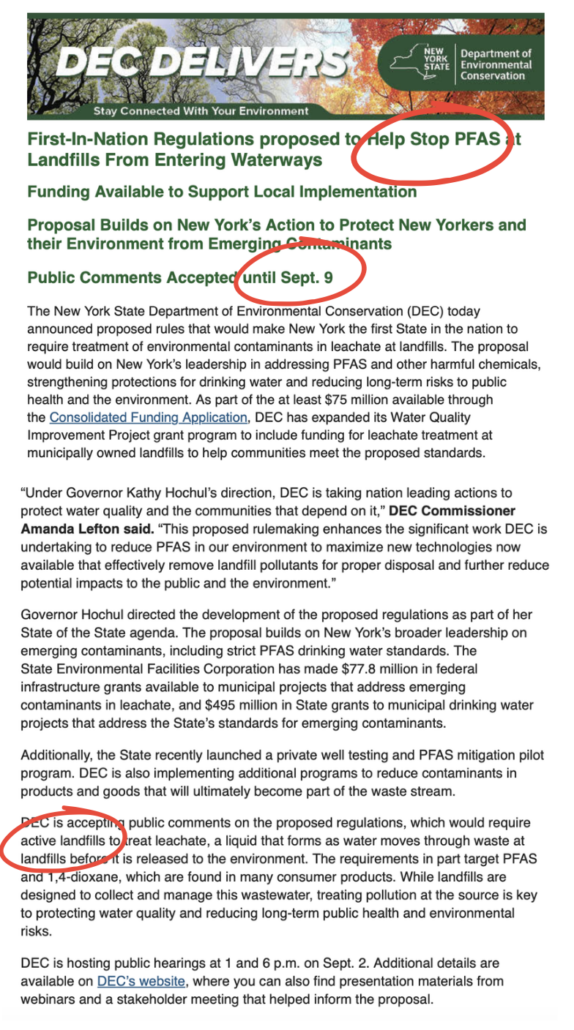
New York State is moving toward requiring landfill leachate to be treated prior to disposal at STPs. This is a positive step, but it raises critical questions about what contaminants will be targeted, how performance will be measured, and what to do with the toxic material once it is separated from the leachate. The NYS Department of Environmental Conservation (DEC) is considering a “performance standard” for leachate treatment, meaning that the concentration of each targeted pollution will need to be reduced by a certain percentage (possibly 99.9%). 

Because the proposed treatment focuses on removal of pollutants, rather than destruction, it is safe to expect that landfill leachate treatment will produce quantities of per-and polyfluoroalkyl substances (PFAS), metals, pesticides, petroleum-based chemicals, and other synthetic chemicals that will need to be disposed of somewhere. DEC does not expect to designate these as hazardous wastes (not that this type of designation would be free of similar questions). The agency plans to place the pollution removed from leachate back into municipal landfills. It has also floated the idea that landfills may be allowed to use this material as alternative daily cover, potentially mixed into concrete. 

Is this a good solution? Thinking about that led us to ask a long list of questions: What is daily cover? Why is it used at landfills? What is alternative daily cover? Why does an alternative exist? What types of materials are typically used as alternative daily cover? How might the well-being of people who live near landfills be affected when toxic chemicals sit exposed on top of garbage? This blog post explores those questions.

What is daily cover, and why is it used?

Landfills are required by federal and state law to cover up each day’s garbage with a material that controls “disease vectors, fires, odors, blowing litter, and scavenging.” This daily cover requirement, along with other rules that modernized the landfill industry (such as requirements for liners and leachate collection systems), was put in place in the early 1990s. 

These regulations changed landfill operations enormously, moving the U.S. from an era of small “open dumps” to the large “sanitary” landfills we have now. Many landfills closed, and landfills that wished to continue operating worked to comply with the new standards. Within the waste industry, these changes created a “panic that there would be no space to deposit waste.” They also significantly increased landfill operating costs.

What is alternative daily cover? Why is alternative daily cover used?

Both federal and New York State regulations identify “earthen material” as the default daily cover. However, under the new space and cost constraints that the industry was nervously facing, landfill operators quickly identified the use of clean soil as daily cover as “a waste of space.” From the landfill manager’s point of view, an empty landfill with an operating permit was an investment of time and money. The main objective” was to fill the landfill with the “highest paying commodity.  That was not clean soil. 

The Solid Waste Association of North America’s (SWANA) technical guidance on alternative daily cover sums it up more formally, with a recommendation: “[C]ompacted soil uses up valuable space in a landfill: Landfills are in the business of utilizing space. Efforts to maximize the use of space should be explored.” Thus, from an early stage, landfill operators sought alternatives to using clean soil for daily cover.

What types of materials are used as alternative daily cover?

Federal and state landfill regulations allow for the use of alternative materials as daily cover, as long as they fulfill the same primary criteria. However, neither federal nor state regulations specifically identify what materials might be allowable alternatives. In 1993, EPA published a survey of alternative daily cover materials currently in use across the country. 

The study underscored the role of cost and space constraints in driving selection of alternative cover materials, and the potential of these materials to generate revenue and economize on space. Alongside more than a dozen commercial products designed for this purpose, the report highlighted eight materials that were ordinarily disposed of within landfills, but had been approved by states for use as alterative daily cover. The list included ash, auto shredder fluff, compost, petroleum-contaminated soil, material dredged from water bodies, foundry sand, organic material, and sludge. 

The report paved the way for widespread acceptance of these materials. Increasingly, landfills came to use locally available industrial waste materials as alternative daily cover. This shifted the economics of daily cover. Instead of spending money and space on clean soil for daily cover, landfills used “problem wastes – things that couldn’t generate enough revenue to compensate for the landfill space they consume.” By placing these materials on top of the landfill at the end of the day, instead of within the landfill during the day, landfill operators cut costs, and even generated profits.

What types of materials are currently used as alternative daily cover in New York?

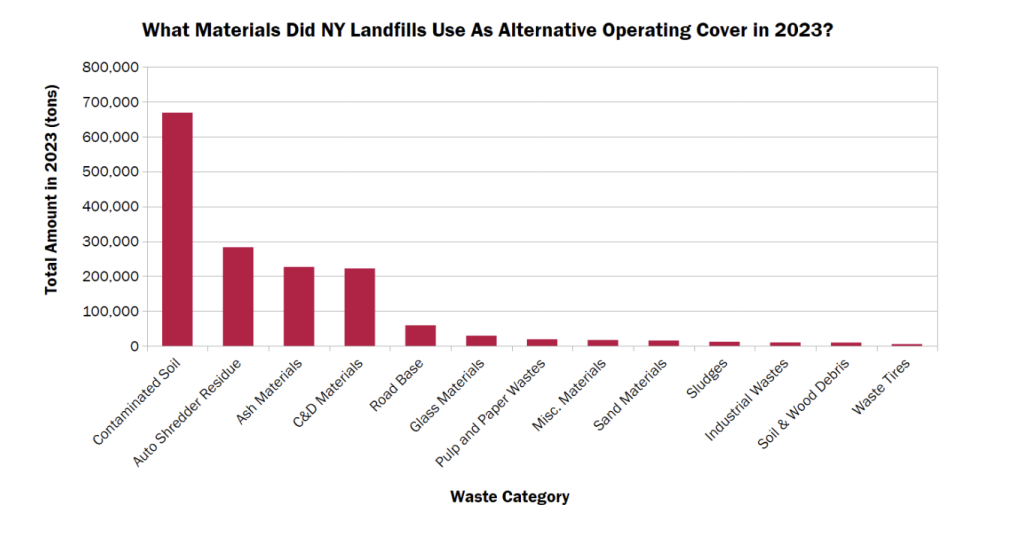
In New York, actively operating landfills report annually on the type and weight of alternative daily cover materials used. We reviewed annual compliance reports from the year 2023 for 25 municipal solid waste landfills in NY, and recorded the types and quantities of alternative daily cover materials used at each one. 

These landfills reported using about 1.6 million tons of alternative daily cover in 2023 (compared to 8.6 million tons of waste). We identified 14 categories of reported materials: contaminated soil, auto shredder residue, ash, construction and demolition debris (C&D), road base, glass, pulp and paper waste, sand, sludge, industrial waste, soil and wood, tires, aggregate/concrete, and miscellaneous (including paper and plastic fibers, fired ware, soil/construction and demolition debris mixture, and other unspecified materials). 

The top five categories by weight accounted for 93% of the total material used as alternative daily cover. These were contaminated soil (42%), auto shredder residue (18%), ash materials (14%), construction and demolition debris (14%), and road base (4%).

The ash materials category included municipal solid waste ash, incinerated sewer sludge, wood ash, coal ash, and unspecified ash. The overwhelming majority – 98%, or 221,000 tons – was municipal solid waste ash. 

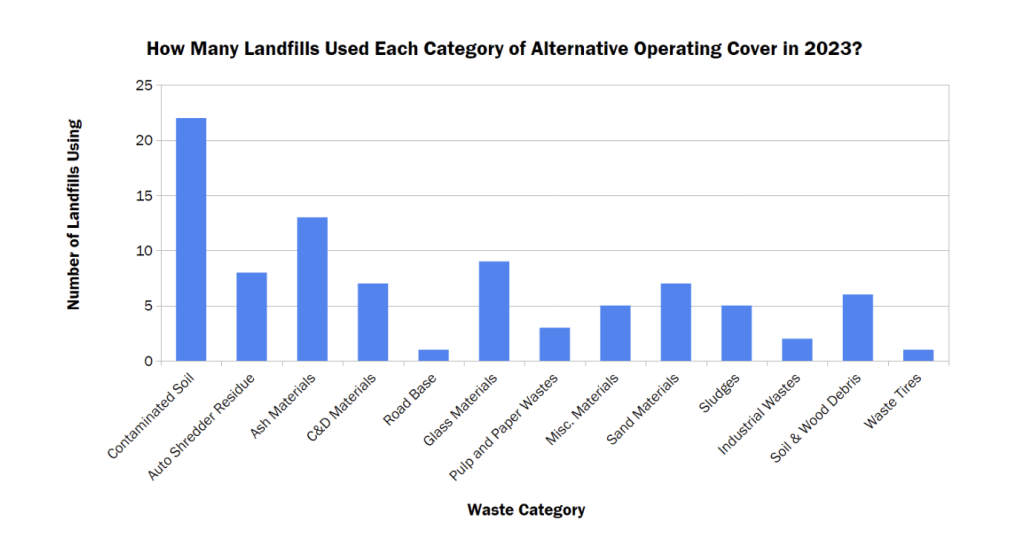
Looking at the number of landfills that used each category of alternative daily cover in 2023 shows that similar materials are most common, but that some materials with very low total tonnage were used at several landfills. The most commonly used materials were contaminated soil (at 22 landfills) and ash (13 landfills), and glass (9 landfills). Auto shredder residue was used at 8 landfills. Construction and demolition debris was used at 7 landfills. 

The data from these 25 landfills shows that landfills across NY take advantage of of the broad availability of contaminated soil and municipal solid waste ash, while also utilizing locally available wastes. 

Are these materials safe to use as alternative cover? 

Federal regulations require that alternative materials must not present “a threat to human health and the environment.” Common alternative daily cover materials – such as ash, auto shredder waste, and contaminated soil – may contain pollutants including metals, polychlorinated biphenyls (PCBs), petroleum, or asbestos at levels requiring their designated as hazardous waste. Several of these materials create blowing dust in dry and windy conditions, and some are prone to fire

SWANA cautions that “most waste ADCs should be tested for hazardous properties prior to using them.” In New York, “All wastes intended to be used as AOC [alternative operating cover] must receive written department [DEC] approval prior to their use.” DEC has the authority to require sampling of proposed materials, although only two standards are written into the regulations: a maximum PCB content of 50 parts per million for auto shredder waste, and a maximum sulfate content of 0.5% by weight for construction and demolition debris. 

Daily cover requirements originated as a way to improve public health and protect the environment. Today, financial incentives drive operating cover material selection, and they lead to the widespread use of risky materials. Just as the benefits of conventional daily cover accrue heavily to people who live near landfills, so do the risks associated with these alternative materials. DEC has acknowledged comments from people concerned that using leachate residual as daily cover may create air pollution, but the agency has not provided details about how air impacts might be managed.

It may be profitable – and legal – to use toxic leachate contaminants as daily cover, but it is a poor choice. As DEC continues to develop its leachate treatment rules, it should seek to minimize the amount of toxic pollution that results from leachate treatment by requiring destruction of as many contaminants as possible. And, it should prohibit the use of leachate pollution as an alternative daily cover.

New York’s PFAS Report: Ten Years of Progress?

At a Glance

In January, New York River Watch celebrated when DEC announced that it would hold two public information sessions on its Onsite Treatment and Disposal of Leachate at Landfills rulemaking. These sessions—hard won by advocates—marked the first publicly advertised opportunity for broad public participation since DEC began communicating and seeking input on the regulation in 2023. Earlier outreach focused primarily on industry stakeholders, while many directly affected parties—including downstream sewage and drinking water treatment plant operators, frontline communities living with landfill pollution, and organizations like ours—were not meaningfully included. As this rulemaking moves forward, it is essential that public participation be treated as a core component of the pre-rule process, with impacted communities and public agencies engaged as early and substantively as industry.   

DEC framed these information sessions within the broader context of New York’s statewide PFAS pollution response. As the state marks ten years since PFAS pollution first came to light, DEC has released a PFAS progress report and scheduled additional public information sessions. 

The report—“A Decade of Progress on PFAS: Summarizing DEC’s Continued Response,”—catalogs actions across multiple state agencies, including site investigation, methods development, data analysis, litigation, product bans, and new regulation. It indicates an attempt by New York State to approach the problem of PFAS contamination comprehensively.

The Question We Need To Ask

Yet, a fundamental question lies beneath the details: If PFAS are toxic, indestructible, and mobile, why are companies still allowed to produce them and incorporate them into so many consumer goods? If we truly want to make progress on PFAS pollution, that is the question we need to ask.

DEC’s report explains that PFAS have been “widely used in various consumer, commercial, and industrial products since the 1940s.” The report leaves out the earlier history of these chemicals, as most PFAS explainers do.1The following history of Teflon is based on the books Exposure: Poisoned Water, Corporate Greed, and One Lawyer’s Twenty-Year Battle against DuPont, by Robert Bilott, and They Poisoned the World: Life and Death in the Age of Forever Chemicals, by Mariah Blake. 

The first PFAS chemical—tetrafluoroethylene, or Teflon—was created by DuPont in 1938. Initially, the company struggled to find a profitable application for it. That changed with the Manhattan Project. The “unique properties” that make PFAS so resistant made Teflon invaluable for developing nuclear weapons. DuPont used Teflon to unlock plutonium fuel manufacturing and become the lead US supplier. 

After World War II, chemical companies including DuPont sought domestic markets to continue selling military-grade chemicals. Teflon was joined by other PFAS chemicals on this trajectory.

By the 1970s, the pollution consequences from this chemical boom had become impossible to ignore, prompting Congressional action. Rather than resist regulation outright, the chemical industry helped shape it. The resulting legislation—the Toxic Substances Control Act (TSCA)—was heavily influenced by industry lobbyists and insiders.2Creager, A.N.H. (2021). To test or not to test: tools, rules, and corporate data in US chemicals regulation. Science, Technology, & Human Values 46(5), 975-977. https://doi.org/10.1177/01622439211013373.

As Mariah Blake writes in her book about PFAS contamination in Hoosick Falls, “It was a DuPont-funded scientist who first articulated the principle that now forms the bedrock of our system for regulating potentially toxic substances—namely, that they should be presumed safe until proven otherwise.”3Blake, Mariah. They Poisoned the World: Life and Death in the Age of Forever Chemicals (p. xiv). Crown. TSCA is part of the industry’s playbook: It is ineffective at regulating chemicals by design.4Creager, A.N.H. (2021). To test or not to test: tools, rules, and corporate data in US chemicals regulation. Science, Technology, & Human Values 46(5), 975-977. https://doi.org/10.1177/01622439211013373. Richter, L., Cordner, A., & Brown, P. (2021). Producing ignorance through regulatory structure: the case of per- and polyfluoroalkyl substances (PFAS). Sociological Perspectives, 1-26. https://doi.org/10.1177/0731121420964827

Chemical companies designed TSCA “to make the oversight of industry difficult,” creating significant obstacles for EPA to require chemical testing data, and broad  opportunities for companies to avoid public disclosure through claims of confidential business information.5Creager, A.N.H. (2021). To test or not to test: tools, rules, and corporate data in US chemicals regulation. Science, Technology, & Human Values 46(5), 975-977. https://doi.org/10.1177/01622439211013373. Yen, J.H., & Bowers K.R. (2021). Title I of the Toxic Substances Control Act (TSCA): A Summary of the Statute. Congressional Research Service Report R45149. https://www.congress.gov/crs-product/R45149 (These claims extend to such basic facts as the identity of the chemical.6Yen, J.H., & Bowers K.R. (2021). Title I of the Toxic Substances Control Act (TSCA): A Summary of the Statute. Congressional Research Service Report R45149. https://www.congress.gov/crs-product/R45149 In fact, claims involving chemical identity make up about half of all confidential business information claims.) Chemicals already on the market—including Teflon, PFOA, and PFOS—were grandfathered in without scrutiny. Although TSCA was amended in 2016, it still doesn’t allow EPA to require companies to routinely submit basic safety testing as part of chemical use applications.7Yen, J.H., & Bowers K.R. (2021). Title I of the Toxic Substances Control Act (TSCA): A Summary of the Statute. Congressional Research Service Report R45149. https://www.congress.gov/crs-product/R45149

The Status Quo Can’t Fix This

We absolutely need to respond to the immediate threat of PFAS and mitigate ongoing harm. But the deeper history of PFAS shows that clean-ups and litigation to make polluters pay will not address the root of the problem. That problem lies in our chemical regulatory system that allows chemicals to enter widespread use without requiring prior safety testing. PFAS also reminds us that substances developed for military and industrial purposes were later repurposed into everyday consumer products, without adequate scrutiny of their long-term impacts on human health and the environment.

When the public began to understand PFAS hazards in the early 2000s, PFAS manufacturers voluntarily phased out the two most infamous PFAS chemicals, PFOA and PFOS. This didn’t stop the release of PFAS into the environment. Instead, production shifted to less-studied forms of PFAS, chemicals lacking documentation of health impacts and environmental interactions that regulators require to develop restrictions. Noncompliance with the phase-out is also a problem.

PFAS are a poster child for just how badly our chemical regulations need to change, and the problem goes beyond them. EPA receives about 280 chemical use applications each year. That’s one for every business day. It receives about the same number of applications for exemption from full chemical review, and about ten times as many confidential business information claims

In this light, an effective PFAS response must confront a hard truth: our existing regulatory framework will not protect us going forward. The answer is a resounding “no.” 

DEC’s PFAS Report equates “progress” with “continued response.” That reflects the values embedded in U.S. environmental regulations, which prioritize industrial activity over human health. Our laws focus on managing pollution rather than prohibiting it. If industrial activity causes harm, the burden is on those who experience it to prove causality before regulation can occur. 

As a result, despite more than 15,000 unique chemicals in the PFAS family, New York State has set surface and drinking water limits for only two.

If we want to change the trajectory of PFAS pollution, we need to shift from a reactive to a precautionary approach. Chemicals should not be presumed “safe until proven otherwise.” They should only be approved if there is reasonable assurance of safety.  Chemical companies should be responsible for providing safety screening data as a part of a request for chemical use approval.  

The systems that allowed PFAS to permeate industrial processes and consumer goods have done the same for countless other hazardous chemicals. Like PFAS, many of these substances ultimately end up in landfills. 

DEC’s forthcoming leachate treatment regulations were prompted by the PFAS pollution crisis, but they hold broader promise: ensuring that many types of toxic chemicals collected at landfills are not released back into the environment, and at the same time, that the concentrate from any sort of treatment not be sent back to the landfill, only to compound the harm.


TAKE ACTION

  1. Attend the upcoming upcoming virtual presentation for the upcoming New York State’s leachate management rulemaking (regulations) on Wednesday, February 11 from 2 – 3:00pm (EST)
  2. Urge DEC to continue outreach to downstream communities and public agencies before finalizing the rule, recognizing that increased awareness often reveals deep public concern about the scale and seriousness of this problem.

NY River Watch Calls on NYS to Protect Waters, Communities, and the Environment from Leachate Pollution in the 2026‑2027 Budget


January 31, 2026

Last week, New York River Watch submitted formal comments to the New York State Legislature as part of the joint Senate Finance and Assembly Ways and Means 2026-2027 budget hearing. Our testimony focused on one of New York’s most urgent—and least understood—threats to drinking water: the ongoing practice of sending untreated landfill leachate to municipal sewage treatment plants.

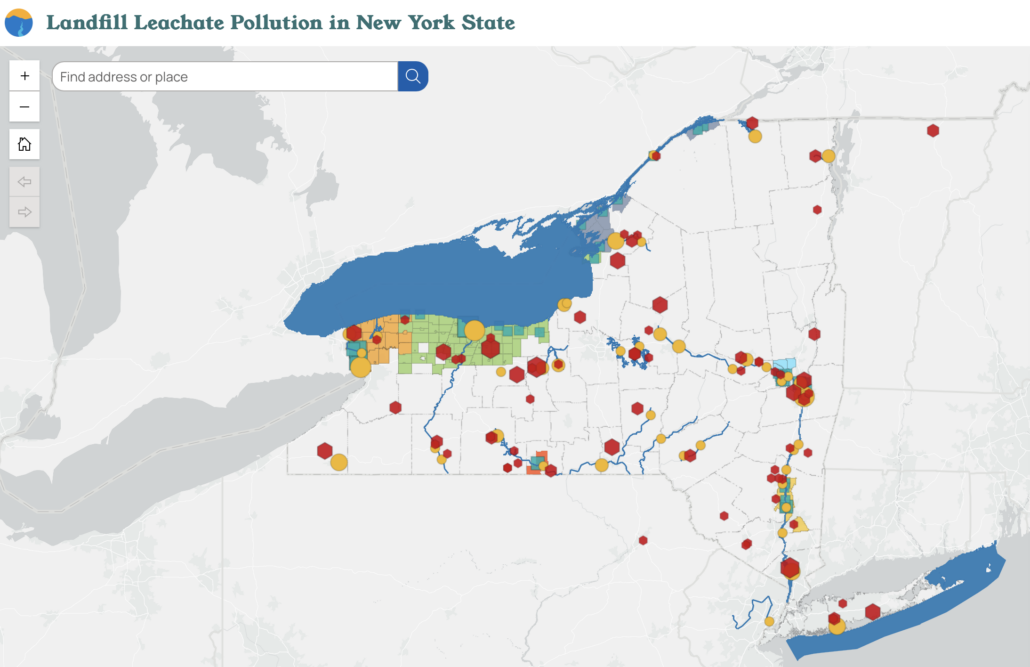
This regulatory gap, known as the “Leachate Loophole,” allows highly contaminated liquid waste from landfills to be trucked or piped to sewage treatment plants that were never designed to remove toxic compounds such as PFAS, 1,4-dioxane, and heavy metals. These pollutants are then discharged into rivers and lakes that supply drinking water for communities across the state.

Under current regulations, landfill leachate is routinely treated as ordinary wastewater—but it is not. It is a complex mixture of contaminants created when rainwater and snowmelt percolate through waste. Most of these contaminants pass straight through sewage treatment plants, ending up in New York’s surface waters. Downstream drinking water plants—and their ratepayers—must shoulder the consequences, mainly unaware of this practice. 

During the budget hearing, Assemblymember Grace Lee (District 55) asked the DEC directly how it plans to ensure that New York’s drinking water is safe in the face of emerging contaminants, including those from landfill leachate.

In her 2026 State of the State (Page 65) address, Governor Kathy Hochul acknowledged the problem, noting that untreated landfill leachate containing PFAS and heavy metals may flow into wastewater treatment plants that cannot remove these substances—risking the discharge of “forever chemicals” into drinking water sources. The Governor’s directive to DEC to establish regulations requiring treatment of leachate at the source is significant. If implemented correctly, this rulemaking could be the first of its kind in the nation and a model for other states facing the same challenge. But ambition alone is not enough.

Even before the specifics of new leachate management regulations are known, the state must be ready to fund their implementation fully and equitably. In our comments to Senate Finance Chair Liz Krueger and Assembly Ways and Means Chair J. Gary Pretlow, we urged lawmakers to prioritize:

  • Adequate and accessible funding for municipalities, particularly those operating municipal landfills, so compliance does not increase local taxes.
  • Funding access for all landfills that generate leachate, to avoid incentives for evasion or noncompliance.
  • Safeguards against consolidation or monopolization of leachate treatment infrastructure by private entities.
  • A full evaluation of environmental justice impacts, ensuring new treatment facilities do not further burden frontline communities already living with landfill pollution.

New York River Watch stands ready to work with DEC and the Legislature as this rulemaking advances. This is a once-in-a-generation opportunity to get it right—for New York and for states watching closely. We will continue to engage, educate, and advocate to ensure that New York’s rivers are protected from this major source of pollution.

New York River Watch and Coalition of Partners Leads DEC to Expand Public Outreach Ahead of Landmark Landfill Leachate Rule


After sustained advocacy and coordination with our partners across New York State, the New York State Department of Environmental Conservation (DEC) has announced two public, virtual presentations on its upcoming rule for On-site Treatment and Disposal of Landfill Leachate. This is an important step forward—and one we’ve been championing alongside our partners.

These presentations will occur on January 27, 2026, and February 11, 2026, both open to all. We are pleased for these public opportunities, which required months of outreach and advocacy by New York River Watch and our partners urging DEC to pause the regulatory process and broaden engagement beyond the landfill industry. 

As awareness of this issue grows, we will continue urging DEC to expand and target outreach specifically to the communities, drinking water systems, and other stakeholders directly affected by leachate pollution before the regulatory process, or “rulemaking,” is initiated.

Landfill leachate—or “garbage water”—is the toxic liquid created when rain and snowmelt percolate through landfills. It contains a complex mix of contaminants, including PFAS, heavy metals, PCBs, and 1,4-dioxane. For decades, the prevailing practice in New York has allowed this leachate to be delivered untreated to municipal sewage treatment plants—facilities that are not designed to remove these chemicals.

As a result, contaminants can pass through treatment plants and enter rivers, lakes, and streams—many of which serve as drinking water sources for millions of New Yorkers. This regulatory gap is what we call the Leachate Loophole.

What is rulemaking?

Rulemaking is how a state agency like DEC creates or updates rules that put laws into practice. In New York State, this process begins when a proposed rule is published, giving the public an opportunity to review it, ask questions, and submit comments. After hearing from the public, the agency can adopt the rule, revise it, or withdraw it. Rulemakings are meant to make sure that decisions affecting communities are not made behind closed doors—and that the people who may be impacted have a real chance to be heard before a rule becomes final. However, members of the solid waste industry have been receiving information about this rule for the past two years, while the public has not. More outreach is needed so that the public can make informed comments.

WATCH:  New York River Watch hosts NYS Rulemaking 101 with Drew Gamils, Senior Attorney at Riverkeeper

Momentum at the State Level

We’re encouraged to see this issue gaining overdue recognition at the highest levels of state government.

In her 2026 State of the State (p. 65), Governor Kathy Hochul highlights the risks posed by landfill leachate being sent to municipal sewage treatment plants. 

“Clean water, vibrant agriculture, and a healthy environment go hand-in-hand. Currently, due to the lack of treatment for liquid waste from landfills that may contain heavy metals and PFAS, this waste may flow into municipal wastewater treatment plants that are unable to remove these substances. This risks discharging “forever chemicals” and other harmful contaminants into our drinking water. To build upon New York’s nation-leading efforts to address emerging contaminants, the Department of Environmental Conservation (DEC) will establish new regulations that instruct landfills to treat leachate for harmful contaminants at the source before discharge; and provide funding for local governments to comply. By treating leachate at the source, we can better protect our environment and our drinking water sources, and save taxpayers millions in future cleanup costs.”

At the same time, DEC has kept the leachate rule—6 NYCRR Parts 360 and 363—on its regulatory agenda for the third consecutive year.

Why Expanded Public Engagement Is Essential

DEC has conducted outreach on this rule to the landfill industry over several years, including multiple presentations to landfill operators, including at industry conferences where stakeholders were already convened. Until now, there has not been a comparable effort to engage:

  • Drinking water providers
  • Sewage treatment plant operators
  • Counties that own inactive landfills
  • Landfill fenceline communities
  • Environmental and public health advocates

This imbalance creates a process that favors industry voices while leaving out communities and public systems directly affected.

The rule will shape how leachate is managed for decades to come, influencing which landfills are regulated, what treatment technologies are allowed, how toxic leftovers—essentially concentrated hazardous waste—are disposed of, and which facilities will be eligible for state funding. Its impacts extend far beyond landfill operators—to water utilities, taxpayers, and the communities living with the cumulative effects of waste infrastructure.

Given the stakes, meaningful engagement can’t be limited to a single meeting or a narrow set of voices. It must include all of those who will be affected. 

Stay Engaged

This rulemaking is a once-in-a-generation opportunity to close the Leachate Loophole and protect New York’s waters. Public participation now will shape whether the outcome truly protects drinking water, public health, and environmental justice—or simply preserves the status quo.

Together, we can work towards landfill leachate no longer being someone else’s problem—downstream.


TAKE ACTION


SIGN UP:  For one or both of the NYSDEC’s presentation on the upcoming rule for Onsite Treatment and Disposal of Leachate at Landfills

VISIT:  New York River Watch, formerly the Hudson and Mohawk Rivers Leachate Collaborative, is a new organization that embraces a holistic approach to protecting New York’s rivers. Our team brings nearly fifty years of experience protecting the Hudson River and its tributaries—a legacy of dedication poured into this work. The Leachate Loophole campaign remains our primary focus, exposing regulatory gaps that allow landfill leachate—a toxic garbage soup loaded with harmful chemicals—to flow untreated into rivers and streams. This harmful practice threatens the health of millions of New Yorkers and the wildlife that depend on these essential water sources. New York River Watch is leading the movement to advocate for comprehensive, sustainable statewide solutions.

JOIN: New York River Watch’s mailing list

FOLLOW: On Facebook and Instagram

READ:  Our report “The Threat of Landfill Leachate to Drinking Water in the Hudson and Mohawk Rivers”

DONATE!  New York River Watch is currently working on the first of its kind statewide report that will show the scope and scale of the landfill leachate entering NYS waters. We need your support! Please consider making a tax-deductible contribution to our important, impactful work!

13 Groups Demand DEC Pause Landfill Leachate Management Rulemaking: New Information Demands Transparency


At a Glance

  • A coalition of groups, led by New York River Watch (NYRW), is asking the NYS Department of Environmental Conservation (DEC) to pause its rulemaking on onsite leachate treatment and disposal.
  • Until now, NYRW has been urging DEC to begin this rulemaking as soon as possible. However, new information shows that DEC has been updating landfill industry insiders on major changes to the proposal, while other key stakeholders have been left out.
  • TAKE ACTION: You can take action by sending a letter in support of pausing the rulemaking so that all affected parties have a fair chance to participate.

On November 13, a coalition of 13 groups, organized by New York River Watch and including the Hudson River Drinking Water Intermunicipal Council (Hudson 7), Seneca Lake Guardians, Riverkeeper, NY/NJ Baykeeper, Peconic Baykeeper, Religious Organizations Along the River (ROAR), Hudson River Sloop Clearwater, TownOfUlsterCitizens.org, Zero Waste Ithaca, Rensselaer Environmental Coalition, Inc and Clean Air Action Network of Glens Falls sent a letter to NYS DEC Commissioner Amanda Lefton, requesting a meeting to discuss DEC’s upcoming leachate management rulemaking. The letter requested that the Department pause the rulemaking and solicit stakeholder input. For the past year, New York River Watch (formerly the Hudson and Mohawk Rivers Leachate Collaborative) has been urging DEC to open this rulemaking immediately. Why are we now asking for a pause? 

NYRW recently learned that between 2023 and 2025, DEC substantially modified its proposed rule changes for landfill leachate management, without engaging in broad stakeholder engagement or notifying the public of updates. During this time, landfill industry insiders had multiple opportunities to hear updates and respond. Other stakeholders – including sewage treatment plant operators, drinking water plant operators, landfill fenceline community members, drinking water consumers, and environmental advocacy organizations – have not had similar opportunities to shape the rule. 

We are all responsible for the trash we create; likewise, the impacts of landfill regulations extend far beyond landfill operators. Stakeholder engagement is necessary to develop regulations that deliver the biggest benefits. 

Why does DEC want to regulate leachate?

Leachate, or garbage water, is the toxic liquid that is created when precipitation percolates through a landfill. It contains a long list of harmful substances – such as petroleum-derived chemicals, heavy metals, PCBs, and PFAS – although the specific composition varies site by site. Because leachate is a well-documented hazard, modern landfills are designed to contain this liquid. However, common practice is for it to be disposed of at municipal sewage treatment plants (STPs), which are not equipped to remove the toxic substances present in leachate. We call this the Leachate Loophole

How has DEC’s rule-making proposal changed?

In response to recent NYS limits on PFOA, PFOS, and 1,4-dioxane, and recognizing that current leachate disposal practices are flawed, DEC began to develop new leachate management regulations. At a stakeholder meeting held on June 7, 2023, DEC recognized the threat that conventional leachate disposal practices pose to water quality and human health. At that time, the Department acknowledged that PFOA, PFOS, and 1,4-dioxane regulations are the tip of the leachate pollution iceberg, so they sought a comprehensive solution by proposing that all leachate be kept onsite at landfills, to prevent the release of any contaminants.

No further information has been released on DEC’s rule-making website since 2023, aside from updates to the expected rule release date (as of November 7, 2025, the website says the rule is expected to be released in Summer 2025). But, DEC delivered presentations to the New York Federation of Solid Waste Associations in 2024 and 2025, showing that DEC has changed its approach substantially (these presentations also mention a second stakeholder meeting that isn’t mentioned on the public-facing website).

DEC’s May 21, 2025 presentation to the landfill industry says that the rulemaking is complete, and is under internal review. The current version of the rulemaking would require leachate to be treated before it is sent to a STP or discharged into water. This treatment may occur at the landfill, or at a treatment facility located elsewhere. 

In contrast to a requirement to keep leachate onsite, the treatment-based approach now proposed would require DEC to identify a concentration limit for every single chemical of concern. We don’t know what the targeted contaminants or concentration limits will be. The new regulations would require “proper disposal” of the contaminants removed from leachate, meaning that they will likely end up back in a landfill. 

The stakeholder engagement process matters

It’s reasonable for a rulemaking proposal to change from start to finish. But the process through which those changes are developed is critical. In this case, DEC has kept the landfill industry in the loop, while overlooking or excluding others. The Department’s 2023 stakeholder meeting centered on the landfill industry perspective, and this same audience has had at least three subsequent opportunities to hear updates. The rest of us haven’t even been informed of these meetings. 

In late 2023, New York River Watch met with DEC Division of Materials Management staff, who mentioned that treatment – rather than containment – might be the way forward. Throughout 2025, New York River Watch requested a meeting with DEC multiple times, without success. A coalition of 20 groups sent a letter to DEC requesting a rulemaking, as did eight municipal bodies. More than 28 elected representatives commented on the issue, reflecting deep interest outside of the landfill industry. Links to some of these comments are at the end of this post.

While the landfill industry has had time to contemplate and discuss the rulemaking, other stakeholders will need to compress that process into a 60-day public comment period (we plan to request 90-days). After that, DEC will choose how to respond (after … receipt of public comment, an agency may either adopt, revise or withdraw the proposal.” See Department of State’s rule-making fact sheet).

What’s at stake?

Once these new rules come into effect, landfills will need to invest in putting new systems into place. Many NYS landfills are municipally operated, placing these costs on taxpayers, and these regulations will influence which facilities are eligible for state and federal funding for treatment systems. As UCRRA Executive Director Marc Rider has noted, “If we’re not regulated, and we still want to treat leachate and do the responsible thing, we won’t be eligible for any of the funds that comes out of this rulemaking. We would benefit from being part of the regulation [rulemaking] process.”

But the effects of these new regulations extend past landfill operations. STP operators handle half a billion gallons of leachate per year (DEC, 2025), at facilities that are not designed for this purpose, and will continue to handle treated leachate discharges. Drinking water treatment plant operators will continue to bear the responsibility of removing any contaminants that aren’t restricted under new rules. Landfill fenceline communities live with the cumulative effects of these massive piles of trash, and will continue to live with the effects of new treatment facilities and “residuals” removed from leachate and placed back in landfills. 

As currently proposed, the regulation will apply to only 32 landfills in the state. It will leave out certain active landfills, and all inactive landfills that collect leachate. In recent years, landfills in Pennsylvania, Massachusetts, Vermont, and New Hampshire have also delivered leachate to NYS STPs, but interstate leachate transport is not mentioned in DEC’s presentations.

A better way forward

DEC is right to update its leachate management regulations. Throughout 2025, New York River Watch has advocated that DEC open this rulemaking immediately, with a 90-day comment period, in order to facilitate the opportunity for public input. However, given what we now know about the rule development process to date, we believe that DEC must pause the rule-making and solicit additional input. Other stakeholders have critical perspectives. 

Leachate is not simply a bullet point in a landfill operating plan. It is a direct link between solid waste and water quality, and its life cycle touches upon much more. Thinking comprehensively about leachate management means thinking about all of the hazards leachate carries, not just a handful of chemicals, and applying the precautionary principle due to the unknowns. Good stewardship requires us to think about how to reduce leachate production, which leads us to consider organic waste, plastic waste, and the goal of closing landfills (since closed landfills produce far less leachate, reducing trash production and closing landfills helps solve our leachate problem). And we must also consider the chemicals allowed in consumer goods, which dictate the toxicity of future leachate.

The root problem behind landfill leachate isn’t any single chemical; it is the landfills themselves. Robust stakeholder engagement is the key to identifying practices that also address environmental justice, climate change, and the broader impacts of landfills. More points of view need to be put in the balance before an approach is selected, so that we can make the best possible decision for the long-term health of people, wildlife, and waters.

###

For more information, here are some links to comments made by elected and municipal officials:

Assemblymember Deborah Glick’s and State Senator Michelle Hinchey’s testimony during budget hearings

Ulster County Executive Jen Metzger’s letter to DEC 

Hudson River Drinking Water Intermunicipal Council’s (Hudson 7) letter to DEC

State Senator Michelle Hinchey’s letter to DEC

Ulster County Legislature’s resolution

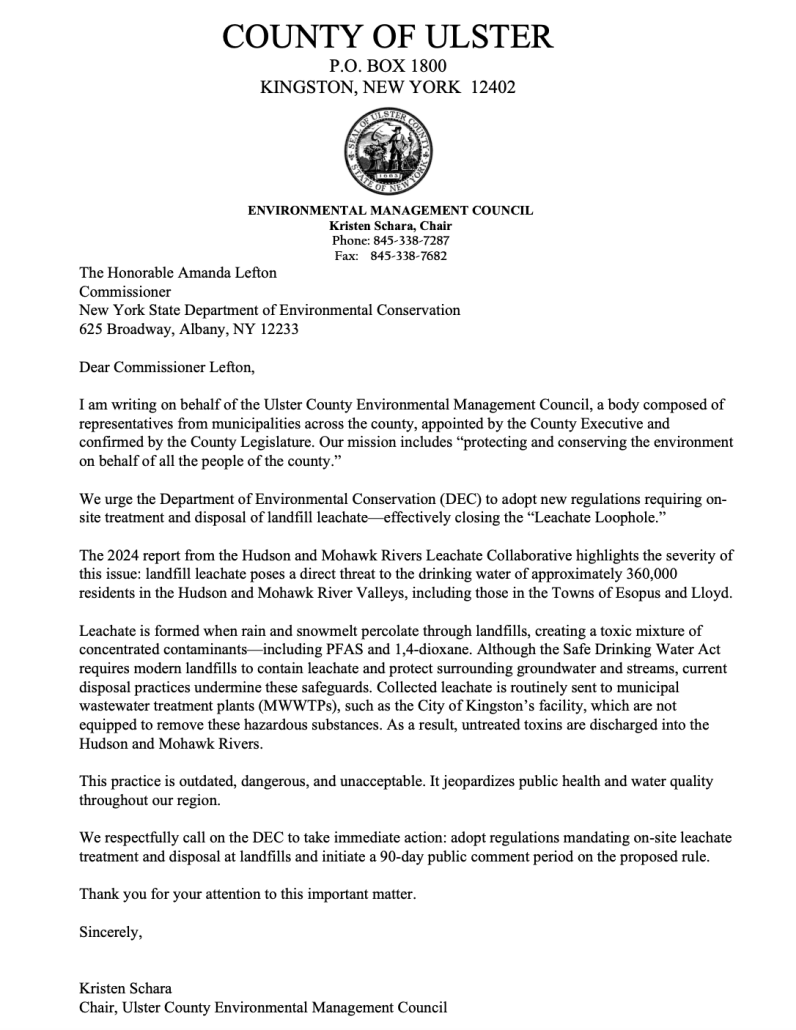
Ulster County Environmental Management Council’s letter to DEC

Kingston Mayer Steve Noble’s letter to DEC
Ulster County Environmental Management Council urge the DEC to adopt new regulations for onsite treatment and disposal of landfill leachate

The Ulster County Environmental Management Council (EMC) has formally urged the New York State Department of Environmental Conservation (DEC) to take immediate action to protect public health and water quality by closing the “Leachate Loophole.”

The EMC is an advisory body made up of representatives from municipalities across Ulster County. Members are appointed by the County Executive and confirmed by the County Legislature. Its mission is to protect and conserve the environment on behalf of all the people of Ulster County.

In a letter recently approved by the Council, the EMC called on the DEC to adopt new regulations requiring on-site treatment and disposal of landfill leachate—the toxic liquid that forms when rain and snowmelt pass through landfill waste.

“Current practices are outdated and unsafe,” the EMC stated. “We need to stop sending this hazardous waste to municipal wastewater treatment plants that were never designed to handle it.”

Leachate often contains harmful contaminants like PFAS and 1,4-dioxane—chemicals linked to cancer and other serious health risks. Yet across New York State, this toxic liquid is still routinely sent to facilities such as the City of Kingston’s wastewater treatment plant, which cannot effectively remove these substances. The result: untreated toxins discharged into the Hudson and Mohawk Rivers.

The EMC’s call to action follows the 2024 report from the Hudson and Mohawk Rivers Leachate Collaborative, which found that leachate pollution poses a direct threat to the drinking water of approximately 360,000 residents, including those in the Towns of Esopus and Lloyd.

As a countywide council advocating for environmental protection and sustainability, the EMC urges the DEC to adopt regulations mandating on-site leachate treatment at landfills and to initiate a 90-day public comment period.

As EPA abandons drinking water protections, New York must step in with a precautionary approach

In June 2017, six months into the first Trump administration, Comptroller Thomas DiNapoli issued a report on drinking water regulation in New York State. Contamination crises in the Village of Hoosick Falls and City of Newburgh had exposed “significant gaps in protections,” and in response, his office analyzed federal and state roles in drinking water regulation. With EPA planning to deregulate and defund environmental programs, DiNapoli advised NYS to act independently. To this end, he suggested “adoption of a more precautionary approach to regulating contaminants.”

Now, months into a second Trump administration, EPA has announced its intention to roll back recently adopted drinking water standards for per- and polyfluoroalkyl substances (PFAS) – the very standards that were designed to protect people from the type of drinking water pollution that people in Hoosick Falls and Newburgh experienced. Nor will the administration defend the standards in court. The administration’s 2026 budget eliminated funding for drinking water infrastructure, leaving only 10% as an “offramp.” As if that’s not enough, EPA has restructured its science division to speed up new chemical approvals, a process that doesn’t even require companies to test chemicals for safety before putting them on the market.

In 2017, given anticipated EPA funding cuts, the NYS Comptroller questioned “EPA’s ability to implement the SDWA effectively.” Today, the answer is clearly “no,” and furthermore, the central question seems to be whether EPA’s leadership even has the will to do so.

So what should New York do?

The suggestion put forth eight years ago by Comptroller DiNapoli is still on point: New York State must adopt a precautionary approach to drinking water regulation. The “precautionary principle” means that when pollution and its attendant harms are reasonably likely to occur, regulators step in to prevent damage before it occurs, even if questions remain. Lingering questions must be addressed before a potentially polluting action moves forward. In contrast, our existing environmental laws kick in after damages occur. People who are harmed by pollution must prove it before chemical restrictions are considered. If restrictions are deemed necessary, developing them requires years of extensive data collection and analyses.

Our lack of precaution has given rise to a vast group of chemicals called “emerging contaminants,” a catch-all title covering chemicals that are suspected to be harmful, but whose risks and exposures are not fully defined. Despite what the name suggests, emerging contaminants aren’t necessarily new. For example, PFAS production began in the 1940s, causing pollution on a global scale – with severe impacts in multiple New York communities – before the public even began to learn of the threats.1

Landfills are time capsules of industrial, commerical, and municipal waste, which release a toxic soup of contaminants as rainwater percolates through them. Modern landfills are required to be lined with impermeable barriers so that leachate does not leak out and pollute neighboring ground- and surface water.2  Instead, the liquid is collected by a network of drainage pipes underneath the landfill. But, despite all the infrastructure to contain and control leachate at landfill sites, the standard practice is to pump it into tanker trucks and haul it to sewage treatment plants, which are not equipped to remove the synthetic chemicals that make leachate dangerous. As a result, they pass through sewage plants into surface waters, including drinking water supplies.

Allowing low levels of polluting chemicals to be dumped into our drinking water is a misguided and unacceptable risk. Some emerging contamiants are bioaccumulative, persistent, and/or harmful in very low doses. PFOA and PFOS, the two best-studied PFAS, are a case in point: EPA’s drinking water standards aim for zero detectable amounts of these compounds in treated drinking water, because no safe level of exposure exists.

Landfill leachate is known to be toxic – this is the very reason that landfills contain and collect it. Yet, regulatory loopholes allow it to be dumped, untreated, into surface waters.A precautionary approach to leachate disposal, one that stops leachate disposal at sewage treatment plants, would put NYS on a better path with regard to drinking water safety.


TAKE ACTION 
Urge The NY Department of Environmental Conservation (DEC) to Adopt New Regulations for On-site Treatment and Disposal of Leachate at Landfills

Subscribe to our newsletter!

Please consider any size donation to our work


1 To learn about how this affected people in Hoosick Falls and other parts of New York, read They Poisoned the World by Mariah Blake.

2 New York State’s ongoing investigation into drinking water pollution from older, unlined landfills shows how real of a threat this is: PFOA or PFOS concentrations in groundwater are above NYS standards at 68% of the landfills that have been tested.

Bearing Witness in Brookhaven, NY: A Visit with Monique Fitzgerald of BLARG (Brookhaven Landfill Action and Remediation Group)

By Rebecca Martin

This summer, a small group of advocates—including Rhonda Keyser, a talented artist, Program and Policy Director at Cafeteria Culture  and member of the Brooklyn Solid Waste Advisory Board, Natalie Russianoff, Program Assistant at Beyond Plastics; and myself—traveled to Brookhaven, NY (North Bellport) to visit Monique Fitzgerald, co-founder of BLARG (Brookhaven Landfill Action and Remediation Group). Visiting coalition partners in person to see the work they are doing and the harms they face is a crucial part of advocacy—what many call “ground truthing”—to truly understand the lived realities behind environmental justice struggles. 

Monique and her nephew welcomed us with incredible warmth and generosity at their community garden, then walked us through the neighborhoods that lie in the shadow of the Brookhaven Landfill. What we witnessed was deeply sobering. From towering mounds of incinerator ash and construction debris to the constant drone of truck traffic, it was impossible to ignore the scale of harm being done here. This landfill is not just a source of pollution—it is a symbol of systemic neglect.

BLARG is a resident-led direct action group rooted in Brookhaven/North Bellport, a predominantly Black and Latino neighborhood adjacent to the landfill. The organization is focused on protecting residents’ health, demanding accountability from local and state governments, and ultimately shutting down the landfill. Monique Fitzgerald herself is a tireless advocate who never shies away from a fight or from helping others. She frequently travels to Albany to speak about the harms facing her community and ensure their voices are heard.

The Brookhaven Landfill has a notorious history of environmental violations. It receives waste from all across Long Island, including highly toxic incinerator ash. This site has been linked to toxic groundwater contamination, including PFAS chemicals, persistent air pollution, and noxious odors that make daily life difficult for nearby residents. The largest source of incinerator ash deposited at the landfill comes from the Reworld Hempstead facility (formerly Covanta Hempstead) in Uniondale, NY. This so called “waste-to-energy” incinerator burns municipal garbage and produces between 500 and 750 tons of ash each day, including fly ash and bottom ash that contain heavy metals and other hazardous pollutants. A 2024 state review found violations in how this ash is handled and tested, yet trucks continue to haul tons of this toxic byproduct into a landfill surrounded by homes, schools, and playgrounds.

Just about 2 miles from the landfill sits Frank P. Long Intermediate School, widely known in the community as the “Sick School”. As of 2019, out of 105 staff members, about one-third have been diagnosed with cancer, and 18 have died. Meanwhile, HELP Suffolk, a family shelter operated by Help USA, provides temporary housing for roughly 76 families experiencing homelessness just next door of the school.  The co-location of a shelter, a contaminated landfill, and a school paints a stark picture of systemic neglect and environmental injustice in the area.

The broader landscape surrounding the Brookhaven Landfill reveals the cumulative impact of decades of harmful land use decisions. In addition to the landfill itself, the area is marked by widespread clear-cutting for industrial warehouse development, a power plant, a county jail, and major truck corridors. These patterns did not arise by chance; they likely reflect long-standing discriminatory planning practices that prioritize industrial infrastructure over the health and wellbeing of low-income communities.

This failure of good planning is reinforced by the fact that the Town of Brookhaven’s last Comprehensive Land Use Plan was adopted in 1996—almost 30 years ago. However, in May 2025, the town issued a Request for Proposals to develop a new town-wide Comprehensive Land Use Plan. This upcoming planning process presents a critical opportunity for residents to shape the future of their community. If done well, a Comprehensive Land Use Plan should reflect the values, needs, and vision of the people it serves. For North Bellport and other frontline communities, it could become a powerful tool in the broader fight for environmental justice, ensuring that future land use decisions protect rather than harm their neighborhoods.

The strength, resilience, and determination of Monique, her family, and the North Bellport community is inspiring. Their fight is far from over, but with continued support, advocacy, and awareness, change is possible.

How to Provide Support

  • Donate to BLARG: Contributions—whether one-time or recurring—help sustain this grassroots movement and support the frontline work being led by residents of North Bellport.
  • Stay Informed: Follow BLARG  to stay updated on developments in the fight against the Brookhaven Landfill.
  • Advocate for Planning Justice: Residents of Brookhaven and the surrounding region are encouraged to engage with the upcoming Comprehensive Land Use Plan process. Ask local officials how the public will be included and demand meaningful, inclusive community participation.
  • Share the Story: Help lift up this fight. Talk to your friends. Share this blog. Invite others to learn more.

###

Rebecca Martin is an advocacy consultant who serves as Project Manager of the Leachate Loophole, Director of Community Partnerships and Training at Beyond Plastics, and Source Water Protection Coordinator for the Hudson River Drinking Water Intermunicipal Council (Hudson 7).  She is also lead strategic advocate and writer for KingstonCitizens.org.

Albany Times Union (Sunday): “What’s in Colonie’s drinking water?”

There was a great letter to the editor in this weekend’s Albany Times Union:

What’s in Colonie’s drinking water?
Albany Times Union (Sunday)
27 Jul 2025

Although it is illegal to discharge landfill leachate directly into waterways, state law allows this poisonous concoction to be piped through municipal sewer systems and then into waterbodies, including the Mohawk and Hudson rivers. There are financial incentives for towns to accept this poisonous waste, including disposal fees that the landfill pays.

Most Colonie and Cohoes residents obtain their household water from the Mohawk. We’d like to know what’s in our drinking water.

Luckily, the state Environmental Facilities Corporation offers grants to determine whether leachate poses a danger to our primary water supply and, if so, to fund a remedy.

In February, our good-government organization, SAVE Colonie: A Partnership for Planning, brought this issue to the attention of Colonie Supervisor Peter Crummey and the Town Board by letter and by in-person public comment at the Feb. 13 board meeting. We also provided information about the EFC grants program. We suggested the town urge the state to eliminate this leachate loophole.

Since then, the silence from our elected officials has been deafening.

Over the past two years, there have been several townwide boil-water advisories and numerous water main breaks due to aging infrastructure. As summer advances, lower Mohawk water levels concentrate pollution, making water safety more concerning.

On behalf of Colonie residents, we ask our government to provide accurate, detailed data on the chemical content of our primary water supply and outline its plans to provide safe water if the Mohawk.

Fred Pfeiffer
Albany