
Understanding the Risks of Using Leachate Residual as Landfill Cover
Takeaways
- As New York State Department of Environmental Conservation (DEC) develops rules requiring landfills to treat leachate prior to disposal at municipal Sewage Treatment Plants (STPs), we must also address what will be done with the concentrated toxic contaminants once they are removed.
- The state has suggested that this concentrated material – sometimes called “residual” – could be placed on top of the landfill each day as an alternative daily cover (ADC) – material used “to control disease vectors, fires, odors, blowing litter, and scavenging.”
- Currently, landfills in New York routinely use materials such as contaminated soil, municipal solid waste (MSW) ash, auto shredder residue, and construction and demolition (C&D) debris as daily cover.
- The use of concentrated leachate treatment residuals as alternative daily cover at landfills should not be allowed.
Why are we talking about alternative daily cover?
New York State is moving toward requiring landfill leachate to be treated prior to disposal at STPs. This is a positive step, but it raises critical questions about what contaminants will be targeted, how performance will be measured, and what to do with the toxic material once it is separated from the leachate. The NYS Department of Environmental Conservation (DEC) is considering a “performance standard” for leachate treatment, meaning that the concentration of each targeted pollution will need to be reduced by a certain percentage (possibly 99.9%).
Because the proposed treatment focuses on removal of pollutants, rather than destruction, it is safe to expect that landfill leachate treatment will produce quantities of per-and polyfluoroalkyl substances (PFAS), metals, pesticides, petroleum-based chemicals, and other synthetic chemicals that will need to be disposed of somewhere. DEC does not expect to designate these as hazardous wastes (not that this type of designation would be free of similar questions). The agency plans to place the pollution removed from leachate back into municipal landfills. It has also floated the idea that landfills may be allowed to use this material as alternative daily cover, potentially mixed into concrete.
Is this a good solution? Thinking about that led us to ask a long list of questions: What is daily cover? Why is it used at landfills? What is alternative daily cover? Why does an alternative exist? What types of materials are typically used as alternative daily cover? How might the well-being of people who live near landfills be affected when toxic chemicals sit exposed on top of garbage? This blog post explores those questions.
What is daily cover, and why is it used?
Landfills are required by federal and state law to cover up each day’s garbage with a material that controls “disease vectors, fires, odors, blowing litter, and scavenging.” This daily cover requirement, along with other rules that modernized the landfill industry (such as requirements for liners and leachate collection systems), was put in place in the early 1990s.
These regulations changed landfill operations enormously, moving the U.S. from an era of small “open dumps” to the large “sanitary” landfills we have now. Many landfills closed, and landfills that wished to continue operating worked to comply with the new standards. Within the waste industry, these changes created a “panic that there would be no space to deposit waste.” They also significantly increased landfill operating costs.
What is alternative daily cover? Why is alternative daily cover used?
Both federal and New York State regulations identify “earthen material” as the default daily cover. However, under the new space and cost constraints that the industry was nervously facing, landfill operators quickly identified the use of clean soil as daily cover as “a waste of space.” From the landfill manager’s point of view, an empty landfill with an operating permit was an investment of time and money. “The main objective” was to fill the landfill with the “highest paying commodity.” That was not clean soil.
The Solid Waste Association of North America’s (SWANA) technical guidance on alternative daily cover sums it up more formally, with a recommendation: “[C]ompacted soil uses up valuable space in a landfill: Landfills are in the business of utilizing space. Efforts to maximize the use of space should be explored.” Thus, from an early stage, landfill operators sought alternatives to using clean soil for daily cover.
What types of materials are used as alternative daily cover?
Federal and state landfill regulations allow for the use of alternative materials as daily cover, as long as they fulfill the same primary criteria. However, neither federal nor state regulations specifically identify what materials might be allowable alternatives. In 1993, EPA published a survey of alternative daily cover materials currently in use across the country.
The study underscored the role of cost and space constraints in driving selection of alternative cover materials, and the potential of these materials to generate revenue and economize on space. Alongside more than a dozen commercial products designed for this purpose, the report highlighted eight materials that were ordinarily disposed of within landfills, but had been approved by states for use as alterative daily cover. The list included ash, auto shredder fluff, compost, petroleum-contaminated soil, material dredged from water bodies, foundry sand, organic material, and sludge.
The report paved the way for widespread acceptance of these materials. Increasingly, landfills came to use locally available industrial waste materials as alternative daily cover. This shifted the economics of daily cover. Instead of spending money and space on clean soil for daily cover, landfills used “problem wastes – things that couldn’t generate enough revenue to compensate for the landfill space they consume.” By placing these materials on top of the landfill at the end of the day, instead of within the landfill during the day, landfill operators cut costs, and even generated profits.
What types of materials are currently used as alternative daily cover in New York?
In New York, actively operating landfills report annually on the type and weight of alternative daily cover materials used. We reviewed annual compliance reports from the year 2023 for 25 municipal solid waste landfills in NY, and recorded the types and quantities of alternative daily cover materials used at each one.
These landfills reported using about 1.6 million tons of alternative daily cover in 2023 (compared to 8.6 million tons of waste). We identified 14 categories of reported materials: contaminated soil, auto shredder residue, ash, construction and demolition debris (C&D), road base, glass, pulp and paper waste, sand, sludge, industrial waste, soil and wood, tires, aggregate/concrete, and miscellaneous (including paper and plastic fibers, fired ware, soil/construction and demolition debris mixture, and other unspecified materials).
The top five categories by weight accounted for 93% of the total material used as alternative daily cover. These were contaminated soil (42%), auto shredder residue (18%), ash materials (14%), construction and demolition debris (14%), and road base (4%).
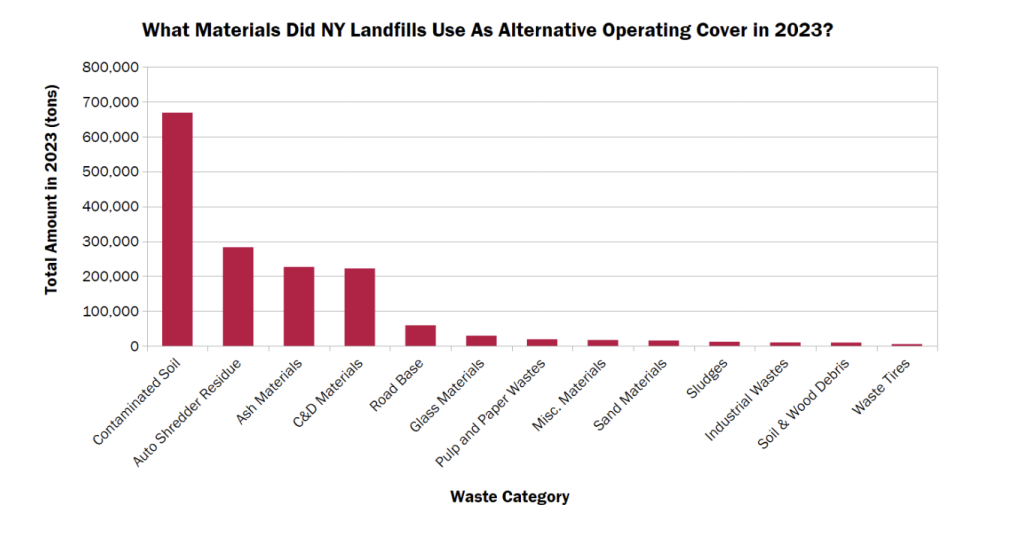
The ash materials category included municipal solid waste ash, incinerated sewer sludge, wood ash, coal ash, and unspecified ash. The overwhelming majority – 98%, or 221,000 tons – was municipal solid waste ash.
Looking at the number of landfills that used each category of alternative daily cover in 2023 shows that similar materials are most common, but that some materials with very low total tonnage were used at several landfills. The most commonly used materials were contaminated soil (at 22 landfills) and ash (13 landfills), and glass (9 landfills). Auto shredder residue was used at 8 landfills. Construction and demolition debris was used at 7 landfills.
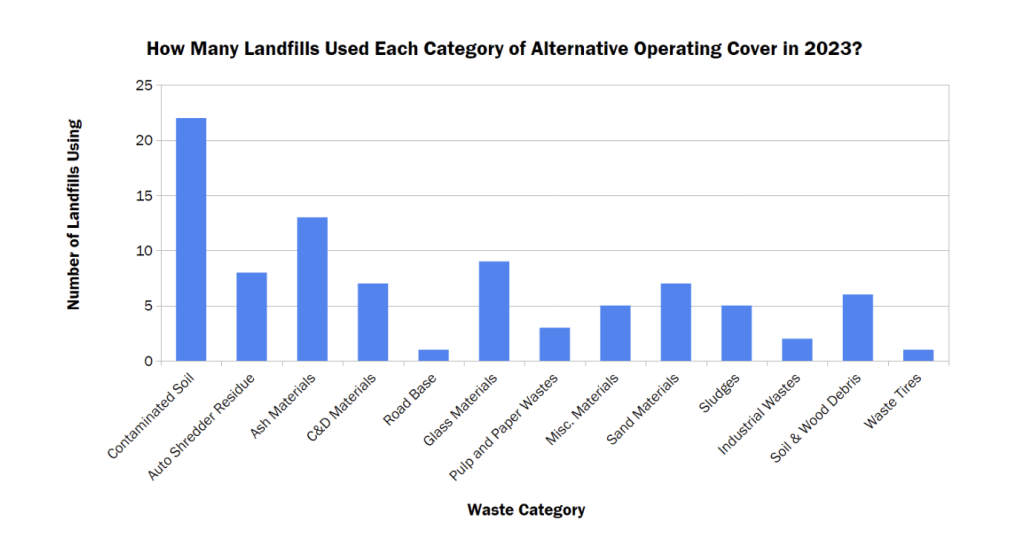
The data from these 25 landfills shows that landfills across NY take advantage of of the broad availability of contaminated soil and municipal solid waste ash, while also utilizing locally available wastes.
Are these materials safe to use as alternative cover?
Federal regulations require that alternative materials must not present “a threat to human health and the environment.” Common alternative daily cover materials – such as ash, auto shredder waste, and contaminated soil – may contain pollutants including metals, polychlorinated biphenyls (PCBs), petroleum, or asbestos at levels requiring their designated as hazardous waste. Several of these materials create blowing dust in dry and windy conditions, and some are prone to fire.
SWANA cautions that “most waste ADCs should be tested for hazardous properties prior to using them.” In New York, “All wastes intended to be used as AOC [alternative operating cover] must receive written department [DEC] approval prior to their use.” DEC has the authority to require sampling of proposed materials, although only two standards are written into the regulations: a maximum PCB content of 50 parts per million for auto shredder waste, and a maximum sulfate content of 0.5% by weight for construction and demolition debris.
Daily cover requirements originated as a way to improve public health and protect the environment. Today, financial incentives drive operating cover material selection, and they lead to the widespread use of risky materials. Just as the benefits of conventional daily cover accrue heavily to people who live near landfills, so do the risks associated with these alternative materials. DEC has acknowledged comments from people concerned that using leachate residual as daily cover may create air pollution, but the agency has not provided details about how air impacts might be managed.
It may be profitable – and legal – to use toxic leachate contaminants as daily cover, but it is a poor choice. As DEC continues to develop its leachate treatment rules, it should seek to minimize the amount of toxic pollution that results from leachate treatment by requiring destruction of as many contaminants as possible. And, it should prohibit the use of leachate pollution as an alternative daily cover.