
13 Groups Demand DEC Pause Landfill Leachate Management Rulemaking: New Information Demands Transparency
At a Glance
- A coalition of groups, led by New York River Watch (NYRW), is asking the NYS Department of Environmental Conservation (DEC) to pause its rulemaking on onsite leachate treatment and disposal.
- Until now, NYRW has been urging DEC to begin this rulemaking as soon as possible. However, new information shows that DEC has been updating landfill industry insiders on major changes to the proposal, while other key stakeholders have been left out.
- TAKE ACTION: You can take action by sending a letter in support of pausing the rulemaking so that all affected parties have a fair chance to participate.
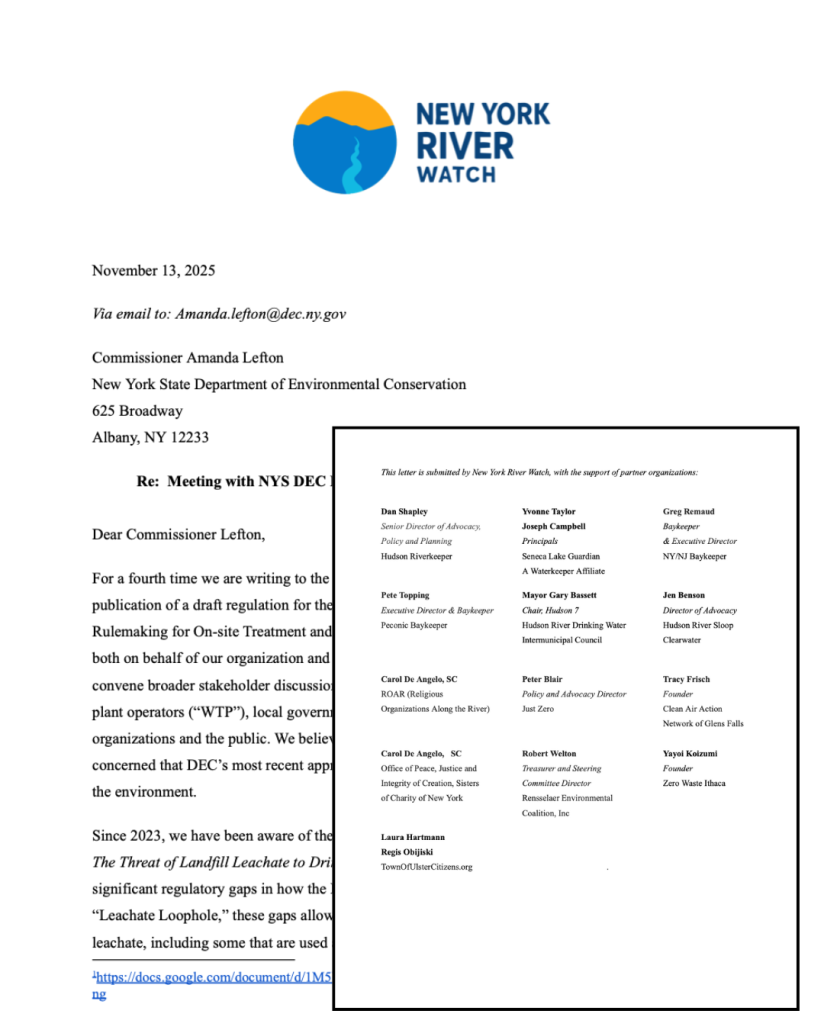
On November 13, a coalition of 13 groups, organized by New York River Watch and including the Hudson River Drinking Water Intermunicipal Council (Hudson 7), Seneca Lake Guardians, Riverkeeper, NY/NJ Baykeeper, Peconic Baykeeper, Religious Organizations Along the River (ROAR), Hudson River Sloop Clearwater, TownOfUlsterCitizens.org, Zero Waste Ithaca, Rensselaer Environmental Coalition, Inc and Clean Air Action Network of Glens Falls sent a letter to NYS DEC Commissioner Amanda Lefton, requesting a meeting to discuss DEC’s upcoming leachate management rulemaking. The letter requested that the Department pause the rulemaking and solicit stakeholder input. For the past year, New York River Watch (formerly the Hudson and Mohawk Rivers Leachate Collaborative) has been urging DEC to open this rulemaking immediately. Why are we now asking for a pause?
NYRW recently learned that between 2023 and 2025, DEC substantially modified its proposed rule changes for landfill leachate management, without engaging in broad stakeholder engagement or notifying the public of updates. During this time, landfill industry insiders had multiple opportunities to hear updates and respond. Other stakeholders – including sewage treatment plant operators, drinking water plant operators, landfill fenceline community members, drinking water consumers, and environmental advocacy organizations – have not had similar opportunities to shape the rule.
We are all responsible for the trash we create; likewise, the impacts of landfill regulations extend far beyond landfill operators. Stakeholder engagement is necessary to develop regulations that deliver the biggest benefits.
Why does DEC want to regulate leachate?
Leachate, or garbage water, is the toxic liquid that is created when precipitation percolates through a landfill. It contains a long list of harmful substances – such as petroleum-derived chemicals, heavy metals, PCBs, and PFAS – although the specific composition varies site by site. Because leachate is a well-documented hazard, modern landfills are designed to contain this liquid. However, common practice is for it to be disposed of at municipal sewage treatment plants (STPs), which are not equipped to remove the toxic substances present in leachate. We call this the Leachate Loophole.
How has DEC’s rule-making proposal changed?
In response to recent NYS limits on PFOA, PFOS, and 1,4-dioxane, and recognizing that current leachate disposal practices are flawed, DEC began to develop new leachate management regulations. At a stakeholder meeting held on June 7, 2023, DEC recognized the threat that conventional leachate disposal practices pose to water quality and human health. At that time, the Department acknowledged that PFOA, PFOS, and 1,4-dioxane regulations are the tip of the leachate pollution iceberg, so they sought a comprehensive solution by proposing that all leachate be kept onsite at landfills, to prevent the release of any contaminants.
No further information has been released on DEC’s rule-making website since 2023, aside from updates to the expected rule release date (as of November 7, 2025, the website says the rule is expected to be released in Summer 2025). But, DEC delivered presentations to the New York Federation of Solid Waste Associations in 2024 and 2025, showing that DEC has changed its approach substantially (these presentations also mention a second stakeholder meeting that isn’t mentioned on the public-facing website).
DEC’s May 21, 2025 presentation to the landfill industry says that the rulemaking is complete, and is under internal review. The current version of the rulemaking would require leachate to be treated before it is sent to a STP or discharged into water. This treatment may occur at the landfill, or at a treatment facility located elsewhere.
In contrast to a requirement to keep leachate onsite, the treatment-based approach now proposed would require DEC to identify a concentration limit for every single chemical of concern. We don’t know what the targeted contaminants or concentration limits will be. The new regulations would require “proper disposal” of the contaminants removed from leachate, meaning that they will likely end up back in a landfill.
The stakeholder engagement process matters
It’s reasonable for a rulemaking proposal to change from start to finish. But the process through which those changes are developed is critical. In this case, DEC has kept the landfill industry in the loop, while overlooking or excluding others. The Department’s 2023 stakeholder meeting centered on the landfill industry perspective, and this same audience has had at least three subsequent opportunities to hear updates. The rest of us haven’t even been informed of these meetings.
In late 2023, New York River Watch met with DEC Division of Materials Management staff, who mentioned that treatment – rather than containment – might be the way forward. Throughout 2025, New York River Watch requested a meeting with DEC multiple times, without success. A coalition of 20 groups sent a letter to DEC requesting a rulemaking, as did eight municipal bodies. More than 28 elected representatives commented on the issue, reflecting deep interest outside of the landfill industry. Links to some of these comments are at the end of this post.
While the landfill industry has had time to contemplate and discuss the rulemaking, other stakeholders will need to compress that process into a 60-day public comment period (we plan to request 90-days). After that, DEC will choose how to respond (after … receipt of public comment, an agency may either adopt, revise or withdraw the proposal.” See Department of State’s rule-making fact sheet).
What’s at stake?
Once these new rules come into effect, landfills will need to invest in putting new systems into place. Many NYS landfills are municipally operated, placing these costs on taxpayers, and these regulations will influence which facilities are eligible for state and federal funding for treatment systems. As UCRRA Executive Director Marc Rider has noted, “If we’re not regulated, and we still want to treat leachate and do the responsible thing, we won’t be eligible for any of the funds that comes out of this rulemaking. We would benefit from being part of the regulation [rulemaking] process.”
But the effects of these new regulations extend past landfill operations. STP operators handle half a billion gallons of leachate per year (DEC, 2025), at facilities that are not designed for this purpose, and will continue to handle treated leachate discharges. Drinking water treatment plant operators will continue to bear the responsibility of removing any contaminants that aren’t restricted under new rules. Landfill fenceline communities live with the cumulative effects of these massive piles of trash, and will continue to live with the effects of new treatment facilities and “residuals” removed from leachate and placed back in landfills.
As currently proposed, the regulation will apply to only 32 landfills in the state. It will leave out certain active landfills, and all inactive landfills that collect leachate. In recent years, landfills in Pennsylvania, Massachusetts, Vermont, and New Hampshire have also delivered leachate to NYS STPs, but interstate leachate transport is not mentioned in DEC’s presentations.
A better way forward
DEC is right to update its leachate management regulations. Throughout 2025, New York River Watch has advocated that DEC open this rulemaking immediately, with a 90-day comment period, in order to facilitate the opportunity for public input. However, given what we now know about the rule development process to date, we believe that DEC must pause the rule-making and solicit additional input. Other stakeholders have critical perspectives.
Leachate is not simply a bullet point in a landfill operating plan. It is a direct link between solid waste and water quality, and its life cycle touches upon much more. Thinking comprehensively about leachate management means thinking about all of the hazards leachate carries, not just a handful of chemicals, and applying the precautionary principle due to the unknowns. Good stewardship requires us to think about how to reduce leachate production, which leads us to consider organic waste, plastic waste, and the goal of closing landfills (since closed landfills produce far less leachate, reducing trash production and closing landfills helps solve our leachate problem). And we must also consider the chemicals allowed in consumer goods, which dictate the toxicity of future leachate.
The root problem behind landfill leachate isn’t any single chemical; it is the landfills themselves. Robust stakeholder engagement is the key to identifying practices that also address environmental justice, climate change, and the broader impacts of landfills. More points of view need to be put in the balance before an approach is selected, so that we can make the best possible decision for the long-term health of people, wildlife, and waters.
###
For more information, here are some links to comments made by elected and municipal officials:
Assemblymember Deborah Glick’s and State Senator Michelle Hinchey’s testimony during budget hearings
Ulster County Executive Jen Metzger’s letter to DEC
Hudson River Drinking Water Intermunicipal Council’s (Hudson 7) letter to DEC
State Senator Michelle Hinchey’s letter to DEC
Ulster County Legislature’s resolution
Ulster County Environmental Management Council’s letter to DEC